 Pam Strayer | Wine Business Monthly
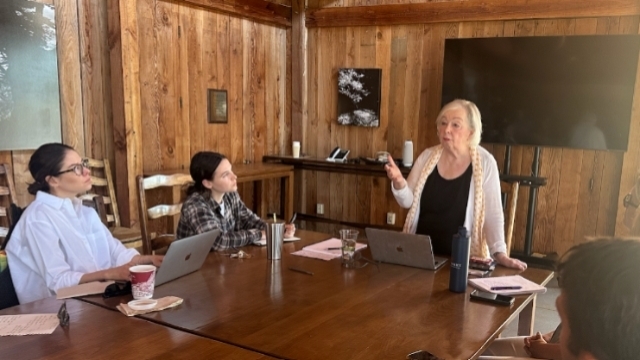
A winery’s pool full of wastewater cleaning worms, peanut butter painted on vines for pest control, and a coffin full of corks were all winning topics the renowned Bloomberg wine columnist Elin McCoy talked about to a group of marketing and PR professionals on Wednesday in a Napa Green sponsored event. Held at Cakebread Cellars, the roundtable workshop was an opportunity to help wineries tell stories of sustainable winegrowing and climate action.
McCoy, a veteran journalist who has written for Decanter, Food & Wine, The World of Fine Wine and a long list of other publications for decades, is also the U.S. correspondent for the podcast The Wine Conversation.
Just back from a trip to Bordeaux for en primeur, she gave candid advice about what to do–and what not to do–in order to get press attention in major media focusing on sustainability.
In a nutshell, her advice boiled down to these high level points:
GENERIC PITCHES VERSUS THE INTERESTING ANGLE
The winery with the worms in the pool wasn’t a story she initially was interested in, because that was not story that was pitched. The initial pitch was far too generic–a guy with a winery, some sustainability practices–she said. But much later, a different person at the winery followed up, and said, “But did you know he has a pool full of worms [cleaning wastewater]?” That got her attention.
She illustrated her talk with another example of an organic vineyard facing an insect infestation and due to their certification, a toxic chemical fix was prohibited. The winery contacted an organic expert consultant, who recommended using peanut butter to coat the vine trunks. The tactic worked. Worth a story.
She also recalled a visit to Chene Bleu in the south of France where vintner Nicole Rolet told her that of all the practices they do, visitors most often mentioned the winery’s bee friendly certification as a highly valued practice.
COMPELLING STORYTELLING
“People like stories about you discovering things,” she said, citing as an example her own essay (later republished in the Academie du Vin book On California), where she talks about being awakened on a visit to Napa by the sound and the smell of vines being sprayed, prompting her to close all the windows in the guesthouse where she had previously been enjoying a bucolic stay.
“People love disaster stories,” she added, suggesting that a topic to pitch might be about a mishap with installation of a solar panel or other piece of equipment, for example.
Discovery stories about animals could also be fertile ground for pitches, she said, citing interest in stories about bats and vineyards’ working horses as examples. Robots and tech are also attention getting.
“In Bordeaux, I saw little grass mowing robots with names–they were cute,” she observed. Frost sensors that provide phone alerts to worrying vineyard managers were another example. “I got one Bordeaux press release that said ‘See the Vineyard of the Future’,” a story she followed up on.
SUPPLY VISUALS
The future included planting rows of fast growing Paulownia trees (tomentosa) which can reach 30 feet in 5 years. The hardwood of the tree is sometimes used to make surfboards, another good story angle. But the kicker was that the winery also provided a drawing of what the tree planting could look like in the future–useful fodder for storytelling at a glance as well as for visually hungry social media.
EVENTS
Pitching a story is not the only way to get attention, she reminded the audience. She recommended attending or creating events and experiences that highlight sustainability practices.
“If you have birdwatching at a vineyard, or a hunt that is biodiversity related,” she said, “that could be good. You could provide a list of the birds to look for.”
She mentioned a winery marketing its unplanted, forested land as a place for visitors to engage in forest bathing, a term and practice created by the Japanese.
Winery marketers can craft specific events to showcase their climate friendly measures in a more dramatic way. She recalled.Randall Grahm, a master of marketing, staging a memorable Death of the Cork dinner to announce Bonny Doon’s adoption of the screwcap. “They even had a coffin full of wine corks,” she said.
LEVERAGE YOUR WEBSITE
McCoy said wineries should include a top level menu item on their website to specifically call out sustainability. She also said many winery websites don’t provide the specific information that wine writers as well as consumers are actively seeking. That includes a centralized place on the website to tout green credentials and practices.
“Wineries should have a fact sheet about their sustainability practices,” she said.
In addition, she said, certifications are complicated and consumers (as well as wine writers) don’t know what they mean.
“Don’t assume that consumers know what your certifications mean,” she said, recommending that winery’s post explainers about their certifications.
GREENWASHING
At the same time, McCoy warned wineries not to greenwash,saying that people will find out about bogus claims. “Be truthful,” she said. On the other hand, she also recommended shining a spotlight on positive steps a winery is taking. “Make big statements,” she said.
NEXT STEPS
After the group broke into small groups to then reconvene and pitch McCoy, one story about a group of Napa Green winemakers’ recycling plastic emerged as a winning pitch. Stay tuned.
CHANDON and Joseph Phelps Vineyards shared their experience with regenerative farming practices, though Joseph Phelps is still in the early stages of regenerative and becoming more biodiverse as they announced their agroecology implementation and vineyard replant plan for their home ranch, which includes a vision for implementing bush and tree systems in the vineyard, and among other elements, cover crops.
The almost day-long event included a series of panels at the CIA at Copia with Cristina Lazcano, Ph.D./associate professor of soils and plant nutrition at UC Davis; Daphne Amory, a biodynamic and organic farming consultant; Anna Brittain, executive director of Napa Green; Adam Koeppel, CEO of Agrology; author and journalist Judith D. Schwartz; Oliver English, CEO of Common Table Creative; and Jesse Smith, the director of land stewardship at the White Buffalo Land Trust in Santa Barbara, Calif. It also included a vertical tasting of Joseph Phelps Insignia wines and a tasting at CHANDON in Yountville.
Q&A Roundtable with Cristina Lazcano and Joseph Phelps Executive Chairman, David Pearson
Lazcano—whose academia interests include soil ecology, biogeochemistry, plant-microbial interactions, rhizosphere ecology, plant nutrition and crop nutritional quality, trophic interactions, greenhouse gas emissions from soils, use of organic waste materials as fertilizers in agriculture, C and N cycling and sustainable soil management—kicked off the first panel session by asking about the state of regenerative farming and soil health.
While there are already 694,733 acres of regenerative farms in the Regenerative Farmers of America network and 5.7 million acres that are regenerative organic certified, Amory noted we’re beginning to deconstruct the understanding around agriculture today and how we engage ourselves around it; we need to re-engage in a way that allows us a way to understand the reciprocal relationships we are all in. In terms of soil health, she said humans have highly degraded it and are continuing to degrade it.
Brittain voiced that when it comes to regenerative agriculture it is critical to take a whole systems approach from farm production to bottle and distribution. At Napa Green, in 2021 and 2022, they redeveloped their vineyard standards to focus on critical items like regenerative practice, climate action and social equity. She said many winegrowers are implementing some regenerative practices, but we are seeing a lack of deep attention to what is underground, to what those indicators of soil health and microbial health are and what we can do to improve our resilience.
Koeppel added that one of the challenges with regenerative agriculture is you cannot see the soil and easily see its health, which is why Agrology wants to help give farmers the ability to connect and understand what is happening with soil—for instance, looking at data on soils where sheep grazing took place versus herbicide application.
He stressed that regenerative agriculture is not a one-size-fits-all approach to agriculture. “It is bespoke, you have to work with the terroir and not against it,” he said, and implement practices that make sense for your vineyard.
Brittain added, do you have to be organic to be regenerative agriculture? While some farms and producers are, she noted the idea of perfection being the enemy of progress—doing a full marathon to get started can be difficult. Koeppel said when it comes to regenerative and starting on that journey, the most important thing is to define goals, around soil health and biodiversity.
During the second panel discussion on telling the story of regenerative ag, Pearson of Joseph Phelps asked, “how do we connect with people on what regenerative agriculture is; how do you keep it real and relevant for people?”
Schwartz said she thinks of it simply. It’s about the understanding of working with nature rather than against it; when we interact and create disturbances within nature it can be degenerative or regenerative. She said people intuitively understand these things, yet people can be disconnected from the natural process but when you talk about it they may have memories of gardening with their grandma or having their hands in the soil and playing and understanding how water works.
Oliver English of Common Table Creative likes to take a macro look at it. He said he believes the regenerative food movement is about how we do more good, how do the choices we make and the food and wine we buy support the stewardship of the planet? This is an opportunity to talk about food flavor, nutritional density and fun—a positive energy that we bring to this world. And sharing stories of regenerative around that frame, whether it’s in film, short stories, or a 30-second Tik Tok, is important.
Making Changes at Joseph Phelps
With the help of Amory, Joseph Phelps Vineyards, which celebrated its 50th harvest in 2023, is in the beginning stages of moving through the fundamentals of regenerative agriculture: which include: Soil health with an eye toward improving soil organic matter content and increasing microbial activity, biodiversity, efficient water management, carbon sequestration, livestock integration for things like rotational grazing, and focusing on community and economic resilience.
Amory said those six things may be fundamentals, but it doesn’t have to be a linear pathway, it is circular because it’s a dynamic system.
The Joseph Phelps home ranch vineyard and visitor center in St. Helena already has some biodiversity with 130 acres of wine grapes and olive orchards, and fruit trees (and in 1999 Joseph Phelps donated a conservation easement over most of the Home Ranch to the Land Trust of Napa County and as a result of this gift, hundreds of acres in Napa Valley are preserved as open space).
According to the presentation, the aim is to build “on the pioneering and innovative spirit of Joseph Phelps by embarking on a new journey.”
Amory said they are in the beginning stages of moving through this system in a way that gives time for reflection and asking questions and finding the answers in the environment. For other projects Amory has worked on, this meant understanding
To come together and reflect, Amory led the Joseph Phelps team in a charette to discuss how they’d work toward the aforementioned concepts of regenerative ag. They considered the current trees, seeds and land, worked to understand the hydrology of the home ranch site with the help of a civil engineer (who mapped and found a whole little watershed unique to the home ranch property), looked at natural carbon storage areas and worked to understand geological factors and alluvial flows. Together, and with the aid of a landscape design team, they came up with a vision for trees in rows—like often seen in places such as Montepulciano, Italy—cover crops and for vines to be planted in such a way that follows more of the contour of the landscape rather than in neat, straight rows.
With this vision you follow the concept of the principals of a living body where the perimeter is the membrane, in-row hedging is the spine, water is at the heart, the forest are the lungs, the brush/tree systems are the vertebrae, the mycorrhizal are the blood vessels and the soils and cover crops are the skin.
She said they have a lot of work to do, but it starts with “picking up a shovel.”
Working with the Land at CHANDON
Over at CHANDON, the Yountville winery has already taken several steps towards regenerative and it has left several large swaths of each of its vineyard sites as natural forest land. The impetus to work more with the land started after the Atlas Fire in 2017, which affected some of its sites.
“It was a moment to recover and rethink our farming towards resilience in the vineyard,” said Carlos Danti, the winegrowing director at CHANDON California.
One of the first things they did was remove the use of herbicides and worked on composting. They brought in more crop diversity to the soils, converted to no tillage and started sheep grazing (2,400 acres were grazed by sheep, good for fertilizer, weed control and soil compaction). They also did cover crop rotations with plants to attract pollinators and also conducted hedgerow planting and riparian area restoration with the planting of 500 oaks and 3,000 linear feet of hedgerows. Additionally, they reduced the use of other pesticide chemicals by utilizing barn owls for pest control and dispersing pheromone sprays with drones to detract vine mealybugs. To further increase biodiversity they installed beehives and vegetable gardens.
They also acquired two electric tractors and installed a solar array.
About Napa Green: The Napa Green 501c3 is a global leader in sustainable winegrowing, setting the highest bar for sustainability and climate action in the wine industry. Napa Green facilitates whole system soil to bottle certification for wineries and vineyards, and provides the expertise, boots-on-the-ground support, and resources to continually improve. Learn more at https://napagreen.org/participating-members/.
Anna Brittain
Napa Green
+1 805-636-3329
email us here
Visit us on social media:
Facebook
LinkedIn
Instagram