All Sustainability Stories, Climate Action, Water Efficiency
The Rutherford Reach restoration project has been lauded for rapid accomplishments achieved through private commitment and public partnership. The statistics are notable:
This project alone achieved more than 80 percent of the mandated TMDL reduction target for the Napa River watershed due to channel incision and bank erosion.
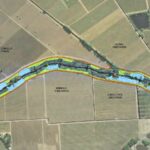
A continuous 4.5-mile river restoration engaging all 30 landowners across 41 parcels.
Includes a 20-year self-assessment to fund the project and provide for ongoing monitoring and maintenance.
31 acres of vineyard land valued at $9 million were rededicated and revegetated to native riparian habitat.
More than 2.5 miles of the channel were widened.
Over 140 in-stream habitat structures were installed to help salmon and trout rebound.
5 beaver dams have popped up where beavers haven’t been seen in decades and Swainson’s hawk, normally found in estuaries, have nested on the Reach.
Davie Piña described going before the Coastal Conservancy to request funding: “When we told them we had self-funded the restoration plan, had every single landowner onboard, a partnership with the Napa Resource Conservation District and the County and more than half of the $20 million raised in matching funds, they were floored. People told us it might take 20 years to break ground. We did it in seven.”
The plan was built from the inside out, with landowners like John Williams of Frog’s Leap, Piña and other Rutherford Dust Society leaders building relationships and trust with all the landowners.
In the late 1990s, berm and levee wars were getting litigious and landowners knew building the river banks higher were just ‘staying away from the river.’ Williams recalled looking at breached berms and eroding and collapsed banks, thinking, “If we tackled these different problems together we might have a better chance.”
The Napa Resource Conservation District (RCD) came to the Rutherford Dust Society and proposed a partnership. Many landowners needed to make expensive and time-consuming repairs. By collaborating, they could see benefits, like getting grants and sharing costs. Initially, each landowner contributed based on the length of their river frontage to privately fund a restoration engineering study. Once complete, a public-private partnership with the RCD was formed, called Rutherford Dust Restoration Team (RDRT), and began restoring and managing the Napa River from Rutherford to Oak Knoll.
"The idea was to restore a whole reach, not just one spot where you have a problem."
Davie Piña
Piña Vineyard Management
There were significant contractual hurdles: landowners had to agree to allow the county and contractors access to their property for at least three years; they had to sign-up for a 20-year assessment of $1.75/foot of riverfront, which applied to both sides of the river if it divided a property in two. RDRT facilitated conversations with regulatory agencies and landowners, taking their requests into account. Even with 30 landowners agreeing, there were still millions of dollars to raise.
Napa County’s Measure A Flood Control sales tax proved to be a lifeline, providing matching funds of approximately $12.5 million. This enabled RDRT to obtain grants from multiple state and federal organizations, totaling another $7.9 million. With funding and a restoration plan with environmental and regulatory approval, they broke ground.
Davie Piña recalled one landowner who admitted he signed initially because he never thought the project would happen. “Ultimately he invited the group over to his house and congratulated us on what we’d accomplished. Another time I ran into Michael Honig, who had seen restoration work being done on another property, and he said, ‘That’s the greatest thing I’ve seen. When do you start on my property?’”
Restoration began in 2009 and was completed in 2014. The Napa County Flood District monitors and maintains the work. Annual reports show the restoration is meeting and exceeding performance standards for project success, including positive trends in channel width-to-depth ratios; increased in-channel gravel recruitment and fine-sediment storage; increased riparian buffer width and vegetation establishment.
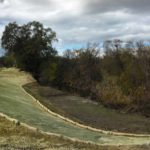
"It’s such a beautiful sight with new terraced banks, and with beaver, salmon and steelhead coming back. It just goes to show that in this age of great skepticism about our political institutions and polarized views about the environment, a group of diverse individuals can find common ground and work constructively with government to build a sustainable river for our future."
John Williams
Frog’s Leap Winery
About napa green
Napa Green is a global leader in sustainable winegrowing, setting the highest bar for sustainability and climate action in the wine industry. Napa Green facilitates systematic soil to bottle certification for wineries and vineyards, and provides the resources, tools and connections to continuously level up leadership. In 2021, Napa Green was the first sustainable winegrowing program in the world to redevelop Vineyard certification standards to focus on climate action, regenerative carbon farming, and social equity. In 2022, Napa Green and community partners launched the first of its kind, six-event RISE Climate & Wine Symposium (formerly THRIVES) with over 65 leading speakers and 40 “Sustainable Services & Solutions” partners and sponsors.