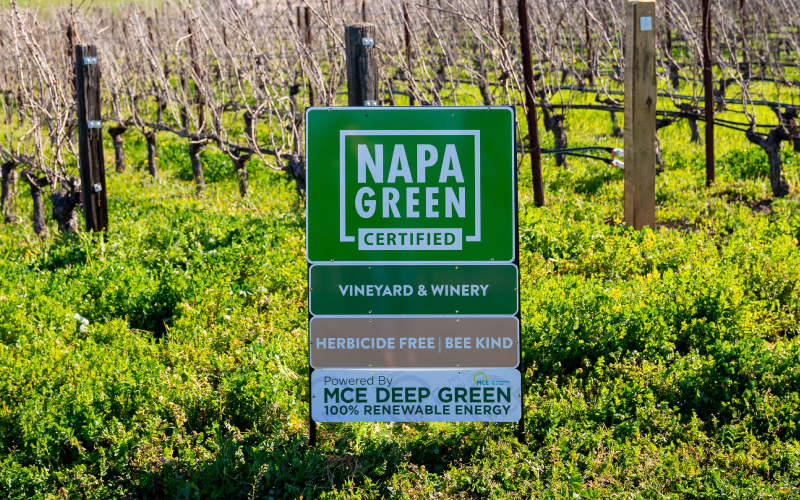
Last month, Napa Green, a sustainable wine-growing certification for Napa Valley vineyards, announced that members must phase out the use of the herbicide glyphosate, the active ingredient in popular weed killer Roundup.
By 2026, the 90 wineries overseen by the nonprofit must find a replacement for glyphosate and by 2028 discontinue use of all synthetic herbicides. It is a consequential decision that will likely deeply impact not just the wineries under its program, but the entire region—and potentially the global industry.
Some in the food and drink space are cheering the move. “The move to eliminate synthetic pesticides in farming use is a massive step to solve a problem that does not get enough attention,” says Sam Bogue, the beverage director of Flour + Water Hospitality Group in San Francisco.
But the decision isn’t universally loved. The synthetic weed killer Roundup is a controversial topic in agricultural and ecological circles. Some love glyphosate’s ability to quickly and efficiently remove weeds, while others are alarmed by several studies linking the herbicide to cancer and environmental issues, which has led some regions to move toward phasing it out. Here’s everything to know about the issue and a look into what the future may hold.
What Is Glyphosate?
Glyphosate was originally developed by Swiss pharmaceutical company Cilag in 1950, but it was found to have no medical applications. Years later, in 1964, the compound received its first patent, which classified it as a metal descaling agent. But its most significant usage was discovered in 1970, when a Monsanto scientist discovered that the chemical is a particularly adept herbicide. When applied to the green stems of a weed at the appropriate time, it infiltrates and kills those unwanted plants, ostensibly without being absorbed into the roots, ruining the soil or affecting cultivated crops like vines. In 1974, the company released this miracle weed killer under the name Roundup, though the patent expired in the 2000s and similar products (like Lifeline) have since come onto the market.
Roundup, which is now owned by Bayer after it acquired Monsanto for $63 billion in 2018, has since become ubiquitous. It’s the world’s most popular weed killer, used on a massive agricultural scale and in home gardens. In 2018, nearly 42% of Napa vineyards and 55% of Sonoma’s were sprayed with glyphosate. Its use in the larger agricultural system is even more substantial. In the United States, more than 90% of corn, cotton, soybean, canola and sugarbeet crops are modified to be tolerant to glyphosate. And 77% of global soybean production comes from glyphosate-treated soybeans.
The draw is apparent—it’s effective and cheap. Wineries spray it to kill weeds that spring up under vines and compete for water and energy. Glyphosate is cheaper and less time-consuming than manual weed control, which helps to lower labor costs and avoid trunk damage caused by weeding machinery. After spraying herbicide, the vineyards rows are left clean and pristine.
This ease of use is why it’s become a tentpole for American agriculture. A July 2023 report from Aimport Research predicted that a future without glyphosate would be costly to farmers and disproportionately affect small farms. “The loss of glyphosate would not be trivial,” it says. It also found that the switch could cause the rapid release of greenhouse gasses and increase production costs, potentially raising food prices for consumers in the midst of an already-tough period of inflation. It is worth noting, however, that the study was commissioned by Bayer.
As the years have passed, other studies have not been so complimentary. Research has suggested the herbicide is detrimental to the environment. In particular, the belief that glyphosate does not damage soil quality has been called into question, with at least one study showing that it kills microorganisms that plants need and disrupts microbes in the soil. A 2019 study published in the peer-reviewed journal Plants found that “despite favorable evaluations of weed control efficacy, an increasing number of more recent observations suggest a relationship between extensive glyphosate application and adverse nontarget effects in agroecosystems,” meaning it can harm plants and animals beyond its intended use. Further studies suggest additional impacts to ground and surface waters, increased earthworm mortality, as well as its potential to harm aquatic organisms, bee colonies and worker health. For Napa Green, the herbicides’ potential damages outweighed the draws.
“As we’ve reviewed the standards, more and more science has come out about the risk of synthetic herbicides to soil health and microbial and fungal diversity,” says Anna Brittain, Napa Green’s executive director. “The human health risks are more debated, but we’re being proactive with our decision.”
It’s hard to definitively say how glyphosate impacts human health because it’s everywhere. A 2022 study from the Centers for Disease Control and Prevention found that 80% of adults had traces of glyphosate in their urine. But, as the years have passed, scientists and public health experts have found some evidence that it does cause harm. In 2015, the World Health Organization’s International Agency for Research on Cancer classified the herbicide as “probably carcinogenic.” A 2021 study flagged glyphosate as a possible cause of Non-Hodgkin’s Lymphoma.
Thousands of lawsuits have been filed linking Roundup to cancer—including an October 2023 case involving a Carlsbad man diagnosed with cancer after decades of working with Roundup. The jury found that the company had failed to warn users of the risks of the herbicide. He was awarded $332 million in damages.
Bayer remains firm that glyphosate is not a carcinogen. A 2016 study, funded by the company, determined “there is no validated or significant relationship between exposure to glyphosate and an increased risk of non-Hodgkin lymphoma or other types of cancer.” The U.S. Environmental Protection Agency and the European Food Safety Authority both take the stance that glyphosate does not threaten human health when used correctly.
Even so, Luxembourg banned glyphosate in 2020 due to suspicions of cancer-causing properties, though this ban was lifted recently by court mandate. Austria and Germany have banned glyphosate from public spaces, while the Consorzio of Conegliano Valdobbiadene Prosecco Superior DOCG, a protected wine region in the Veneto region of northwest Italy, forbade the use of glyphosates in 2018, advising growers to use mechanical mowing and other alternative vineyard management techniques instead. “The goal of the Viticultural Protocol is to progressively eliminate practices and substances that are considered to have too great an environmental impact—even if they are still permitted under the Italian and European regulations,” the DOCG stated at the time.
Shrouded in Controversy
With so much controversy surrounding Roundup, why haven’t more regions shifted away from the weed killer?
French president Emmanuel Macron began the process of eliminating glyphosate from France in 2017. “I have asked the government to take the necessary steps to ban the use of glyphosate in France as soon as alternatives are found, and within three years at the latest,” he said at the time. The announcement caused an uproar with the country’s agricultural giants. Six years later, the pledge has not been fulfilled.
One of the main drivers for keeping glyphosate around is its low-cost and availability. After the patent expired in the 1990s, rival versions and low-cost alternatives came to market. Bayer (then-Monsanto) became one of many producers of glyphosate herbicides, dropping prices and leading to oversupply.
On November 18, the European Commission announced it will move to allow glyphosates for another decade, causing an uproar amongst glyphosate detractors. But the decision was far from unanimous—the vote was split, the Commission overruled the decision and glyphosate was reauthorized until 2033. German-owned Bayer commended the decision.
Winemakers are equally divided. Some are strong anti-glyphosate advocates, while others rely on the weed killer to meet supply demands. As mentioned previously, around half of the vineyard acreages in both Napa and Sonoma is treated with the herbicide. Yet, in spite of its widespread usage, no winery would go on record for this article in favor of Roundup.
Allison Wilson, Cliff Lede Vineyards’ director of vineyard operations, phased it out in 2019. “We started to notice that the soil was getting a bit tired and the biological activity was less than optimal,” she says. “We haven’t looked back.” They have since started incorporating compost to bring life back into the soil and shifted to no-till practices.
She thinks Roundup is on the downswing, a fad that’s phasing out. “There was a time when it was really popular for Napa Valley vines to be kept really pristine and clean, and that’s what the valley would use Roundup for,” says Wilson. “I think consumer and winemaker feelings have turned—people are okay with a little bit of weed under the vines, as long as you can properly manage it.”
At Ashes & Diamonds in Napa, vineyards are lush and green, full of blooming flora and active fauna. Instead of using Roundup or similar products, the viticulturists use another Bayer product, biological fungicide called Serenade, seaweed extract, compost and pyrethrum extract to manage pests and keep vines healthy.
“We’ve never used glyphosates,” says Kashy Khaledi, the winery’s proprietor. “We’re happy to see glyphosates have been identified by Napa Green as the harmful, destructive chemicals they are.”
Rutherford’s Inglenook equally avoided the weed killer—it was one of the first 10 estates in Napa to farm organically. The team is currently initiating a Napa Green certification and the glyphosate ban will not deter this. Another 25 certified Napa Green growers are transitioning away from the herbicide, while 48 others have started the process of seeking certification. ADAMSVS, Grgich Hills Estate, Paul Hobbs Winery, B Cellars, Hyde Vineyards, Raymond Vineyards and Bell Wine Cellars are just completing their Napa Green Vineyard certification process. All together that represents more than 7,000 vineyard acres.
“The amount of effort required to change farming practices is worth it for the future of Napa Valley,” says Ashes & Diamonds’ director of vineyard and cellar operations Enrique Herrero. “Some may think that phasing out synthetic herbicides is overreaching or extreme, but it unquestionably supports sustainability.”
The Struggle With Shifting From Roundup
Making the transition isn’t easy. Growers can weed by hand (expensive and labor-intensive), employ sheep (which require management) or adopt gas-powered tools to control weeds—and thereby increase carbon emissions. A French study found that the cost of mechanical weeding is on average €250 per hectare more than glyphosate chemical weeding.
“Shifting does drive up the cost of winemaking, especially labor and investment in mechanical implementations,” says Wilson. “The hardest part for growers is going to be the first two vintages while you’re trying to get the roots strong. Getting those vines established is a big investment.”
After the Luxembourg glyphosate ban, vintner Roger Demuth told local paper RTL that it had been been a tough transition. “The work is harder and costs more energy,” he told the publication. “To weed one hectare of vines with a tractor, it takes you four hours easily. But with glyphosate it only takes you one hour.” One study found that European ban of glyphosate could result in economic losses of up to €553 a hectare.
To help coax wineries away from synthetic herbicides, Napa Green is offering $60,000 in grants, access to economic case studies and weed management tool kits.
“The cost of transitioning away from glyphosate/Roundup is very context specific and depends on a number of factors, including whether new equipment needs to be purchased, if new grazing practices are employed if additional labor needs to be brought in, if the property is level or heavily sloped,” says Brittain.
But making the switch could prove cost effective in the long run. In one of Napa Green’s offered case studies, Grgich Hills, which transitioned away from glyphosates 20 years ago, noted they now spend $11,000 acre, compared to the Napa Valley average of $14,800 an acre. In Grgich’s vineyards, workers now mow only vineyard alleys (using a Twister machine under the vines) and employ sheep for the rest.
“We’re trying to provide as many resources as we can to help with the transition,” says Brittain. “We pulled together economic case studies on successful herbicide-free and organic vineyards to help with the costs.” She’s found wineries that have transitioned quickly find that the cost of change is offset by no longer needing herbicides, which have become increasingly expensive. Due to Covid-inflicted supply chain slowdowns, glyphosate prices have risen to up to $50 or $100 an acre for crops like corn and soybeans, up from a few dollars in the early aughts. In the last three years, glyphosate prices have soared as much as 300%.
Then there are the potential health benefits for staff, land and surrounding communities. “Napa is the crown jewel of domestic viticulture and while the wines are consistently lauded for their quality, the reality of production weighs heavily and affects the most vulnerable members of that community,” says Bogue.
Wilson cites the health risk as a big motivator for Cliff Lede to move away from Roundup. “We have young kids and they’re being raised on property, so it was a natural decision to phase it out.”
Still, both Bogue and Wilson acknowledge that the decision to phase out glyphosate will cause a rift in the valley. “I know this decision won’t immediately be popular with my peers who have been farming for a long time, but I just think it’s the right environmental and moral decision,” says Wilson. “The writing has been on the wall for years.”
For this reason, back in 2021 Napa Green established the “Six Pillars of Sustainable Winegrowing Leadership.” The Six Pillars are: I. Water Efficiency & Savings; II. Energy Efficiency & Savings; III. Waste Prevention & Supply Chain; IV. Proactive Farming, Soil Health & Biodiversity; V. Social Justice, Diversity & Inclusion; all under the umbrella of VI. Climate Action & Regenerative Agriculture. Essentially, Napa Green has created two intersecting leadership roadmaps that encompass these Six Pillars, with >100 leading Vineyard practices, and >120 leading Winery practices that growers and vintners have to implement (and be third-party audited) to swing that green metal sign.
Napa Green emphatically believes that a whole-systems approach from the farm, through production, to the people that make it all possible, is critical to meaningful climate action and impact. We see the Six Pillars as a filter that can be used to evaluate any business or organizational claims of sustainability and ask, “Are they really leaders? Are they really taking a whole-systems approach?”
You Mean Organic?
When we talk about sustainable farming or agriculture most people think of organic farming. We will delve into this in more detail in another feature, but if you think about the Six Pillars and a whole-systems approach, not using synthetic pesticides or herbicides, while valuable, is just one small piece of a much bigger puzzle. In terms of environmental stewardship, organic only relates to farming, and focuses on a narrow “don’t,” without addressing broader “dos” of resource use efficiency, climate action, and social equity. Napa Green Vineyard certification includes Prohibited & Restricted Pesticides, including a requirement that members phaseout Roundup/glyphosate-based products by January 1, 2026, and all synthetic herbicides by January 1, 2028, but again this is only one of six elements that certified growers have to address.
What is Climate Action?
Climate action refers to choices that reduce emissions (like using less energy and fuel), drawdown or sequester/store carbon (like compost and cover crops), and cultivate healthy ecosystems more resilient to weather extremes including drought, high heat, and atmospheric rivers. Almost all Napa Green certification standards relate to climate action.
For instance, the Napa Green “Social Justice, Diversity & Inclusion” standards include living wage, benefits, education and opportunities for advancement to help ensure that employees feel safe, secure, and listened to. This is foundational to building engaged and empowered teams that contribute to growing climate-smart businesses.
Napa Green growers implement “Carbon Farm Plans,” custom-developed for them by the Napa Green vineyard team. These plans layout opportunities to build soil health, store carbon, and cultivate more resilient vineyards such as reduced tillage/tractor passes, expanded cover crops that can attract beneficial insects, reduced fertilizer use, planting hedgerows that can provide habitat for natural predators like bluebirds and raptors, bringing in sheep as natural lawnmowers and fertilizers.
Napa Green vintners reduce water use, which reduces the energy needed to transport, heat and treat that water, which reduces emissions. They also “green” their packaging, such as eliminating Styrofoam and opportunities like lightening glass bottles (reduced emissions to manufacture and transport), shifting from wood boxes to lighter and recyclable cardboard, and using natural corks instead of non-recyclable screwcaps and plastic closures.
This is a quick introduction to the Napa Green Vineyard and Winery certifications. We look forward to sharing more and spotlighting leadership stories in these monthly features. Here are a few testimonials from our members about what they get out of being Napa Green: