
Pam Strayer | Wine Business Monthly
The final, “big picture” day of Napa Green’s third RISE Climate & Wine Symposium presented an almost dizzying array of global, national and local experts grounded in both science and viticulture who shared best practices on everything from gully stuffing, rehydrating vineyards and the vital importance of using native plants in cover cropping to dam removal and the return of salmon, fire prevention grants, student activism, and insights from a world renowned ecosystems and biodiversity expert.
While it might be easy to dismiss these topics as economically non-essential, presenters made the point that fire, water and climate are affecting the wine industry and recommended essential steps to mitigate those impacts in order to make the industry resilient.
The May 8th event was the sixth in the six day series of RISE sessions, which will all be posted on risegreen.org’s website in the coming weeks.
Morning Session: Can Forest & Creek Restoration Create Localized Climate Cooling?
An eclectic panel featuring an artist, watershed experts and a Napa vineyard director focused on practices that could change climate impacts on a regional scale.
Leading off, the popular California writer and illustrator Obi Kaufman, author of Heyday Books’ popular nature field guides, opened by acknowledging that the day was Sir David Attenborough’s 99th birthday. After southern California experienced massive fires in January, his newest book State of Fire, Why California Burns, became an instant LA Times bestseller.
Fire fears and water woes topped Occidental Arts & Ecology Center’s (OEAC) Brock Dolman’s talk, often delivered in colorful rhyming language that brought amused laughter (as intended) from the audience. Among other things, he advocated for gully stuffing–using downed trees and slash from fire fuel reduction (or post fire clearing) to slow, spread, and sink water in gullies, promoting soil health and water infiltration. OAEC has a video on their website with more information.
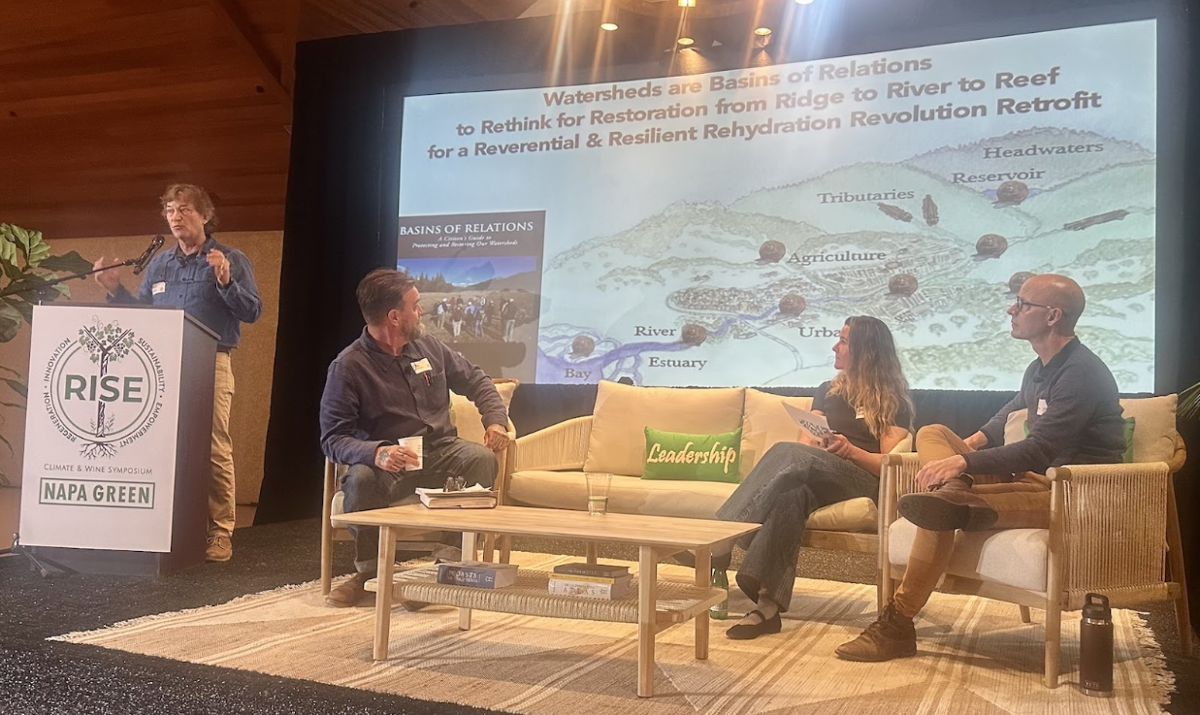
Presenting together, Tod Mostero, director of viticulture and winemaking at Dominus Estate and Mimi Casteel, an Oregon based agroecologist with a degree in forestry, focused on restoring ecosystem function at farm scale and building community to achieve ecosystem wide, watershed goals. (Casteel is a second generation winemaker turned no till evangelist from the pioneering Casteel family who founded Bethel Heights in Oregon.)
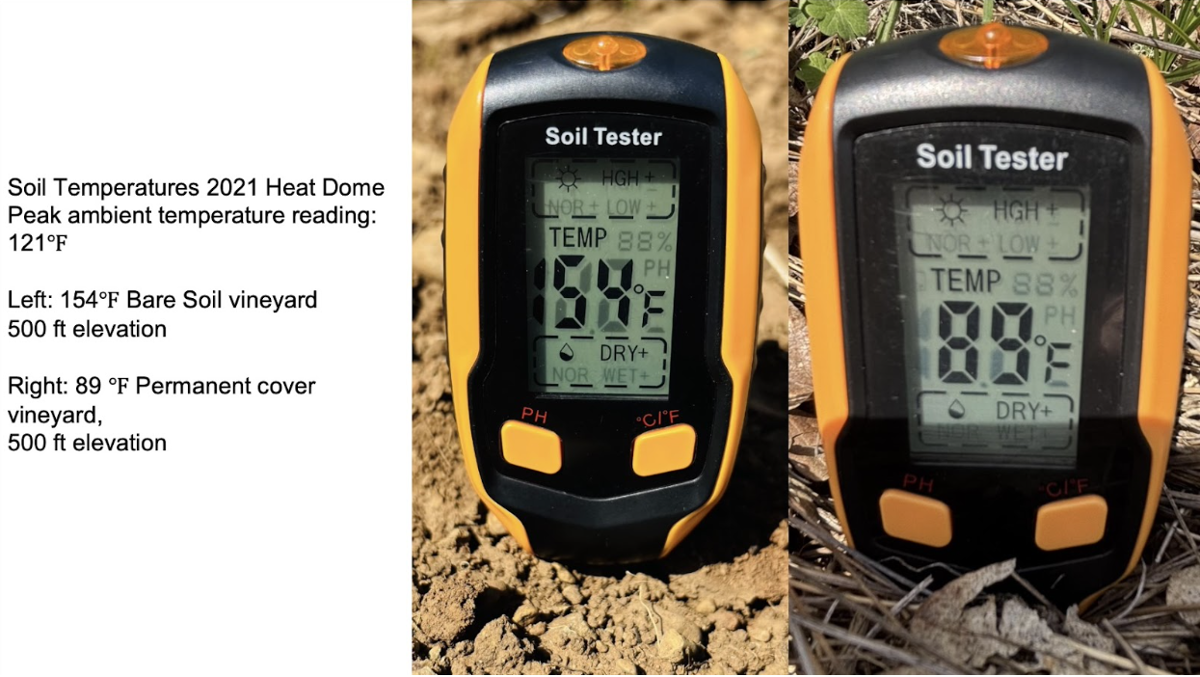
Their joint talk featured a slide on the effects of keeping ground covered, showing that soil temperatures on a heat dome day varied as much as 65 degrees depending on whether the soil was bare or grew a cover crop.
On the water front, they showed data illustrating that with far fewer days of rain, historic monthly maximums can now be daily maximums.
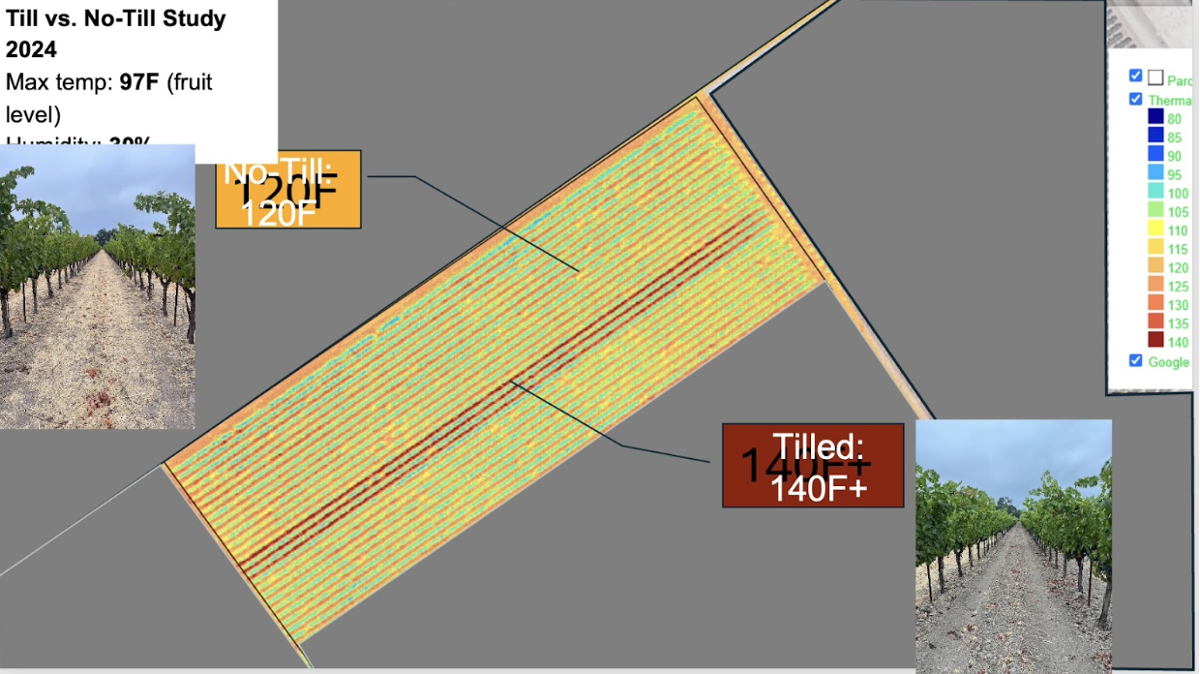
Using VineView data to measure the thermal effects of tillage in 2024 on a 97 degree day, Mostero showed that several tilled rows at Dominus were 140 degrees, in contrast to non tilled rows which registered 120 degrees–a 20 degree difference.
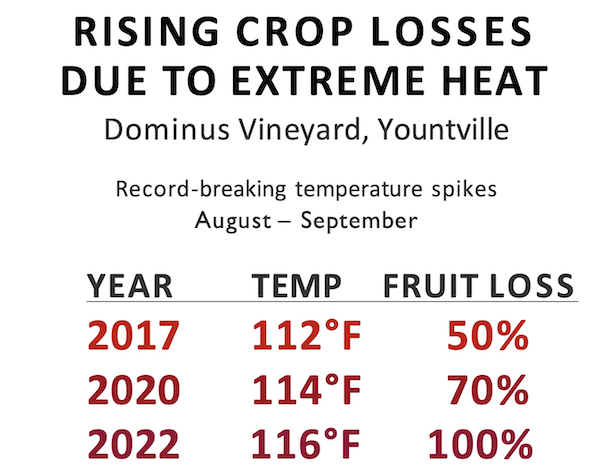
Elsewhere Mostero posted the impact of rising heat on crop losses.
Mostero and Casteel have now launched the nonprofit Abuelitos Foundation to build community around land management and are doing research near Lake Hennessey.
Afternoon Session: Can Wine Really Impact Climate Action?
The all star afternoon panel addressing biodiversity included Napa born Diana Snowden Seysses (a winemaker in both Napa and in France), wine educator and writer Elaine Chukan Brown, and Chilean professor Olga Barbosa, Ph.D., an international expert in ecosystem ecology. Napa Green executive director Anna Brittain moderated.
Snowden-Seysses’ California family’s Snowden Vineyards owns 160 acres of land in the eastern hills of Napa, much of which is forested. “We have block shaped vineyards in the middle of our forests. And we thought that was being green,” she said. But, she added, after the 2020 and 2021 fires,“We realized it was just like a bomb waiting to explode…we just had all this accumulated dry brush material.” They applied for grants, and got funding from the resource district to clear out undergrowth, but that’s covered only a third of the property.
“All of the boon that we have had economically, as people were thirsty during COVID, was sunk into the work that we’ve done thus far. And we’re very proud of it, but it needs to be maintained,” she added. The family is waiting for more grant money and profits in order to go further.
Raised in an Inupiaq-Sugpiaq salmon fishing family in Alaska, Brown applauded the recent dam removal projects that have improved salmon populations.
She also pointed out the downside of previous generations of reforestation in which sugar pines, not native in Mediterranean climates, were planted.
“They’re narrow. The wood is not as dense [as native Mediterranean trees]. They’re much wetter trees, so when they get in heat, they don’t even have to be on fire. When they get in heat, they literally explode from the inside. And when they explode, they spread and they take over the hillside,” she said.
A Biodiversity Scientist’s Perspective
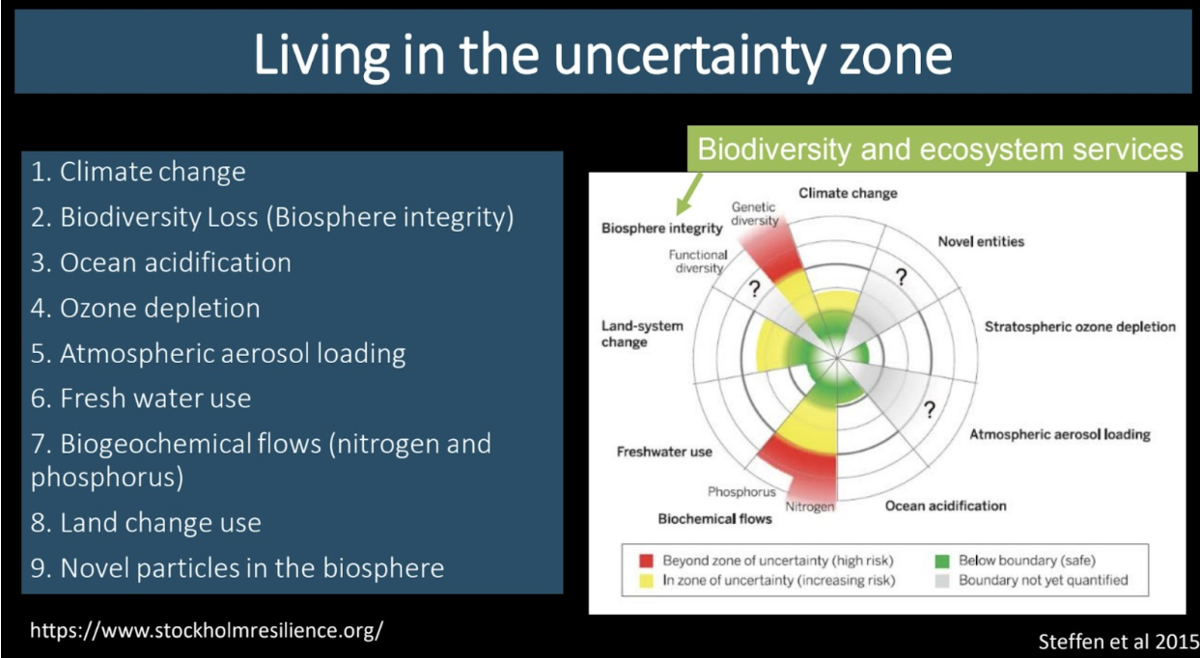
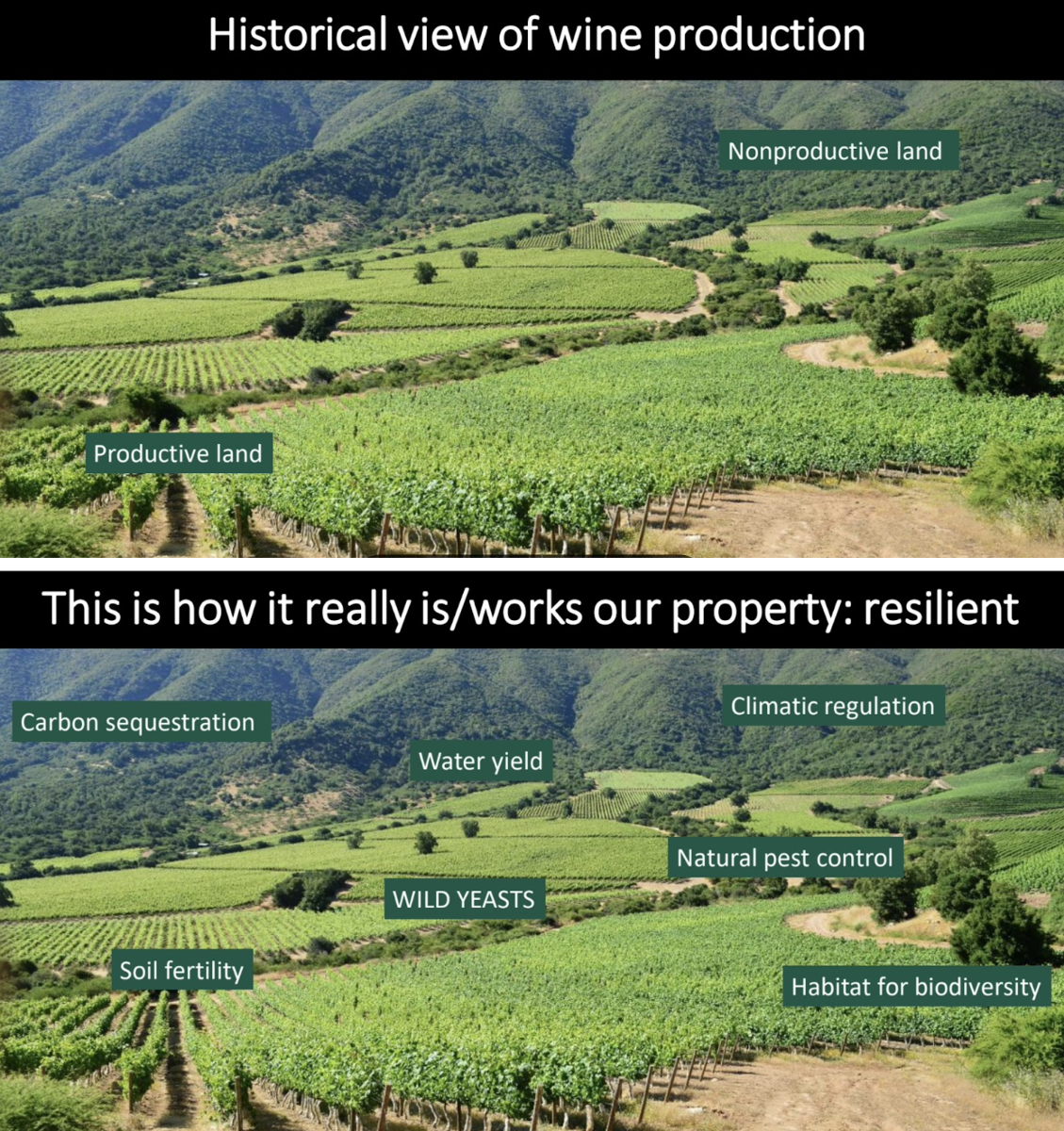
A scientist with a global following, Barbosa, PhD. has worked with leading Chilean wineries (including Emiliana for 15 years) as well as Quintessa and the Napa Valley Grape Growers, to help growers become more resilient in the face of growing uncertainty. She brought a systems perspective, advocating for rethinking concepts about economic models and ag, and pointing to the value that ecosystem services and landscapes provide.
“We have been doing research for 15 years so that we can achieve this conceptualization of the landscape….the interaction of things,” she said.
“We need to talk about a system. When you see the whole system as one, then you will see that there are different benefits and interactions around the system.”
She said conservation is inexpensive and brings financial benefits.
Her advice to growers? “Don’t make a manicured landscape,” she said, adding that nature and biodiversity, and using native species, are the best approach.
“There’s always a risk that we will find an invasive species, and we don’t know how all of them will behave,” she added. Historically, invasive species have created havoc, spreading many vineyard diseases and pests, she said.
Barbosa helped Chilean growers create a new source of cover crop mixes that do not include the California poppy.
She also advocated for creating connected landscapes, used at Emiliana.
In addition to wine grapes, she works with olive oil producers and dairies. She tells producers, “Don’t tell me [conservation] is expensive or that you’re going to lose something. Show me that you are really going to do something. And usually the conversation turns out that they are not going to lose anything.”
Integrating social collaboration is another aspect of her work, which seeks input from everyone. “The guy that does the pruning–that’s the guy that knows where the species that we are looking for are… the CEO might know other things,” she said.
“When you see the whole system as one, then you will see that there are different benefits and interactions around the system….If you have special vegetation that is unique to [your] place, would that signature be in your wine?”
Thanks to the @naparegister for publishing this Climate Connection contribution from @napagreen’s Vineyard Program Director, Ben Mackie (@soilrainandhope) highlighting the biodiversity @grgichhillsestate.
If you loved this article, you’ll love our Birds, Bees & Butterflies: Biodiversity in the Vineyard workshop happening today!
#climateaction #regenerativeag #regenerativeviticulture

Friday night dinner dilemma?
Order takeout from @southsidenapa using promo code DONATE and 20% of your order will be donated to @napagreen.
It’s a win: win! You get dinner and @napagreen gets funding to contribute our impactful climate action work in Napa Valley.
Order online or preorder your Fried Chicken Friday pickup for February 27, 2026. Don’t forget to pair it with Napa Green certified wine! 🍽️ 🍷
#dineanddonate #nonprofit #napavalley
Join us Thursday, February 26 to learn about biodiversity in the vineyard.
🍇 Ivo Jeramaz, Winemaker & VP of Vineyards and Production at @grgichhillsestate, will welcome us to the beautiful property and illustrate the various implementation of habitat diversity they have undertaken at the American Canyon ranch.
🍇 Jo Ann Baumgartner & Sam Earnshaw from @wildfarmalliance will provide insight on how to maximize bird habitat and establish hedgerows to support the local ecology.
🍇 Erin Arnsteen from the @monarchjointventure will outline how pivotal vineyard acreage can be to support the dwindling Western Monarch populations.
🍇 Cori Carlson, owner of @napapastureprotein, will explain the ecological goals of grazing a vineyard.
🍇 Ruby Stahel from the @naparcd will join us to discuss the various resources that the RCD has to support habitat enhancement on Napa properties.
🍇 @soilrainandhope from @napagreen will talk about bees!
➡️ Ticket link in bio.
#biodiversity #regenerativeag #regenerativeviticulture
Learn about the herd of cattle calmly grazing the vineyards @ruddestate, contributing to soil health and biodiversity, in our latest post from @soilrainandhope.
➡️ Link in bio.
#climateaction #regenerativeag #regnerativeviticulture #soilhealth
Thanks to @naparegister and @kcuz for this great article about the @regenerativeviticulture and @napagreen #OneBlockChallenge field day @celaniwines.
We had a great time engaging with attendees about opportunities to implement regenerative practices in their vineyards!
If you’re regenerative curious or want to learn more head to the link in our bio!
#climateaction #regenerativeviticulture
Congratulations on @napagreen Vineyard Certification to @shadybrookestatewinery!
Nestled in the picturesque heart of Coombsville, Shadybrook Estate, has shown a deep commitment to regenerative viticulture and climate action. Visit to see the natural beauty of this hidden gem.
#climateaction #regenerativeviticulture #napagreen
We love the biodiversity in this @grgichhillsestate American Canyon Vineyard!
Come learn how to integrate biodiversity in your vineyard on February 26 at this workshop with @napagreen, @grgichhillsestate, @wildfarmalliance, @monarchjointventure, @napapastureprotein and @naparcd.
➡️ Ticket link in bio.
#Biodiversity #RegenerativeAg #RegenerativeViticulture
Congratulations to @rutherfordhillwinery on achieving @napagreen Winery Recertification!
At Rutherford Hill Winery, sustainability is apparent in all of their practices. The facility is 100% solar-powered and even contributes clean energy back to the local grid. Additionally, they prioritize natural solutions, like Owl Boxes and organic farming.
Visit to experience for yourself these exceptional wines that invest in our planet’s future.
#climateaction #winetasting #sustainablewine
Biodiversity is essential for any resilient vineyard.
Join us on February 26, 2026 at @grgichhills American Canyon to learn how to integrate biodiversity within vineyard blocks.
Experts from @wildfarmalliance @monarchjointventure @napapastureprotein and @naparcd will be on hand to discuss all the various species that a vineyard can support.
Ticket link in bio.
#biodiversity #regenerativeag #regenerativeviticulture
Learn how @closduval used Verallia lightweight glass to help reduce their environmental impact and meet their sustainability goals.
Read more at napagreen.org
#climateaction #lightenup
What a great #OneBlockChallenge first field day!
Not only was it a gorgeous day with a great community of people we also heard from some awesome speakers:
🍇 @cainethompson about the @regenerativeviticulture foundation and the implementation practices
🍇 Jordan Lonberg @coastalvineyardcare about continuous improvement and shifting the industry mindset
🍇 @soilrainandhope about the practical aspects of the regeneratives practices and how @napagreen and @naparcd can provide support
🍇 Dustin Owen @celaniwines about their their vineyard’s regenerative journey
Thanks to all who attended and to @celaniwines for hosting!
➡️ To learn more about regenerative vineyard practices or to enroll in either the One Block Challenge or Napa Green Vineyard certification, head to the links in our bio.
#regenerativeag #climateaction
Join our first @napagreen and @regenerativeviticulture One Block Challenge Field Day to hear from this great lineup of speakers, meet other participating growers, and learn how to take the first steps in implementing regenerative practices.
We look forward to seeing you on February 12, 2026 at @celaniwines to connect learn more.
Registration link in bio.
#regenerativeag #regenerativeviticulture #soilhealth
It’s hard to believe it’s already been 3 years since @marisataylorwines joined our team, but time flies when you’re having fun (and wine)!
Join us in celebrating Marisa Taylor, who is an accomplished winemaker and sustainability leader with over two decades of experience in the wine industry, and also the Napa Green Winery Program Manager, where she partners with wineries across Napa Valley to advance meaningful environmental stewardship and sustainable winegrowing practices.
Thank you for bringing your passion and positive energy to our team every day!
The team celebrated with our @napagreen certified #NapaNeighbors @rombauervineyards.
#winebusiness #womeninwine #sustainablewine
Join us for the @napagreen and @regenerativeviticulture #OneBlockChallenge first field day on February 12, 2026 from 10-12 @celaniwines.
This event is open to all winegrowers and vintners who are curious about regenerative viticulture but space is limited so register today at the link in our bio.
#soilhealth #regenerativeviticulture
Congratulations to @domainecarneros for receiving the @napachamberofcommerce Sustainable Business of the Year award presented by @mcecleanenergy.
Thank you for your leadership, innovation and dedication to sustainability and the community!
#greenbusiness #winebusiness #napagreencertified #napagreen
@antinorinapavalley family’s winemaking legacy spans over six centuries. To ensure that legacy continues, they have a deep commitment to sustainability and the care of the land for future generations.
Hear why Antinori is exploring the use of @hopenvironmental1965 soil compostable tie tape in the vineyard.
#regenerativevineyard #greenbusiness #sustainablewinery #greenpurchasing #landstewardship