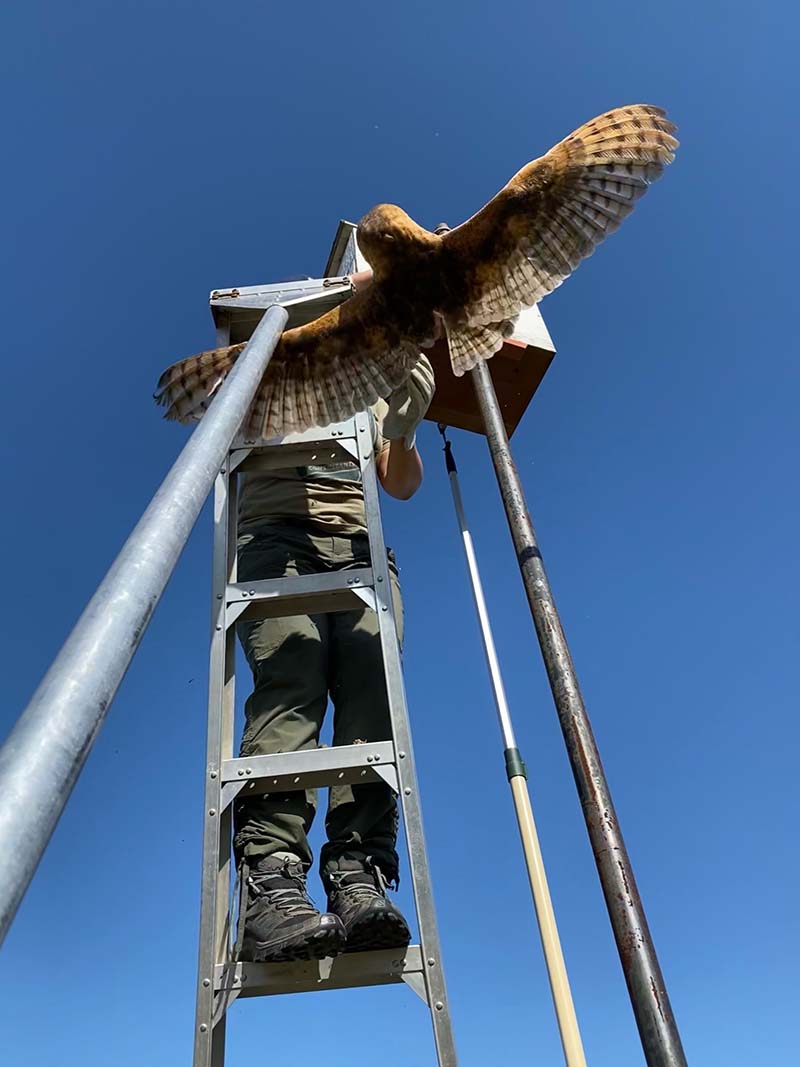
Laura Echávez is perched precariously atop a 16-foot ladder next to a slender pole that is supporting a wooden box the size of a carry-on suitcase. She thrusts her hand inside the box, wriggling fingers through owl pellets, feathers, and fragments of eggshells heaped inches thick. A white fluff-ball of a barn owl chick tries to grab her gloved hand while its mother and siblings hiss a staticky barrage of white noise. When Echávez ventures a peek inside, she is hit by a salvo of bones and dried owl poo from defensive birds. And the smell? “Like cat urine,” Echávez says.
Her plunge into the dim domain of this barn owl family is hands-on science. Echávez, Samantha Chavez, and Jaime Carlino, all graduate students at Humboldt State University, are spending morning after morning monitoring barn owl nest boxes scattered throughout the sun-drenched vineyards of Napa Valley. The data they are collecting will not only deepen our understanding of how these birds, in their role as natural predators of rodents, contribute to reducing the environmental footprint of the $9.4 billion industry that has made Napa Valley an internationally known wine region. It will also help determine how vineyard nest boxes are affecting barn owls.
“It’s not just a pest control service, like a transactional thing,” says Matt Johnson, a Humboldt State wildlife professor who is supervising the multiyear research program.
Rodent pests have been a problem for crop-growers since Neolithic farmers pioneered planting wheat, millet, and spelt, and humans have been teaming up with raptors to hunt small prey for thousands of years. More recently, the “if you build it, they will come” idea has persuaded Malaysians to erect barn owl nest boxes on palm oil plantations, Kenyan maize farmers to install nest boxes and raptor perches, and Israelies to put 1,500 nest boxes in agricultural fields as part of a national program. Over the last two decades, farmers throughout the United States have increasingly turned to raptors to reduce the rodents that damage their crops.
Managing pests is a primary challenge facing California’s vintners. Winegrape growers in Napa Valley launched their own raptor pest control efforts in the 1980s, when decades of using commercial fertilizer and a nothing-but-grapes monoculture began catching up with them: having long touted the particular taste of their wines and their unique connection to the land, vintners were realizing their beloved terroir had acquired a toxic taint. Replacing pesticides with barn owls for rodent control was one of several innovations that marked a new appetite for more environmentally sustainable production. Many growers have also begun planting perennial grasses between rows; some are experimenting with reduced or no tilling and no water.
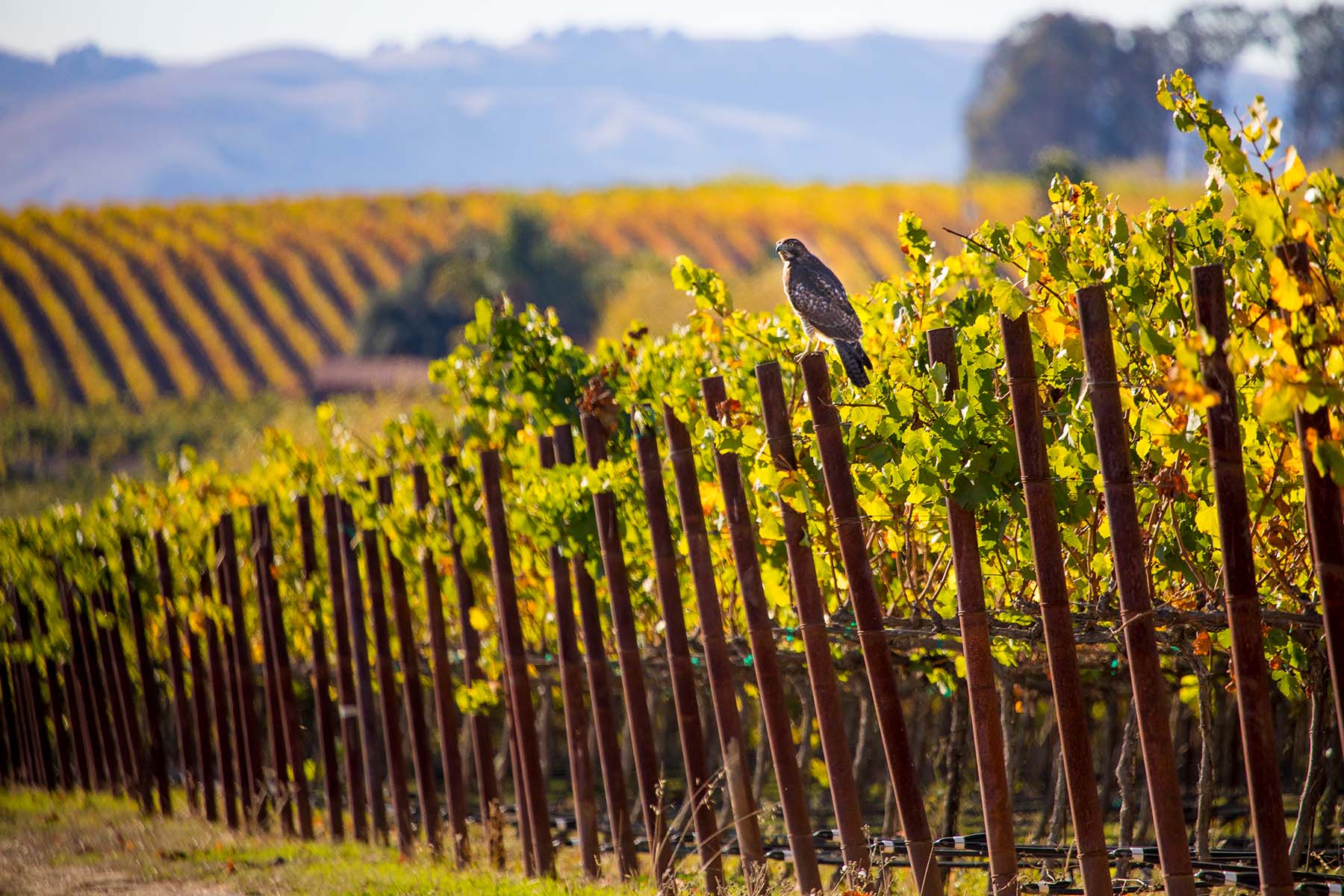
Today, owl boxes rise out of row after row of vineyards like skinny sentinels protecting precious purple gems. In a survey of 75 California vintners, four-fifths say they use the boxes and are convinced that owls help to control rodents, Johnson says. He wanted to know how and how much, so he launched a series of scientific studies in 2015 to determine where owls hunt in vineyard areas, how many rodents they remove, and whether they are actually reducing pesticide use.
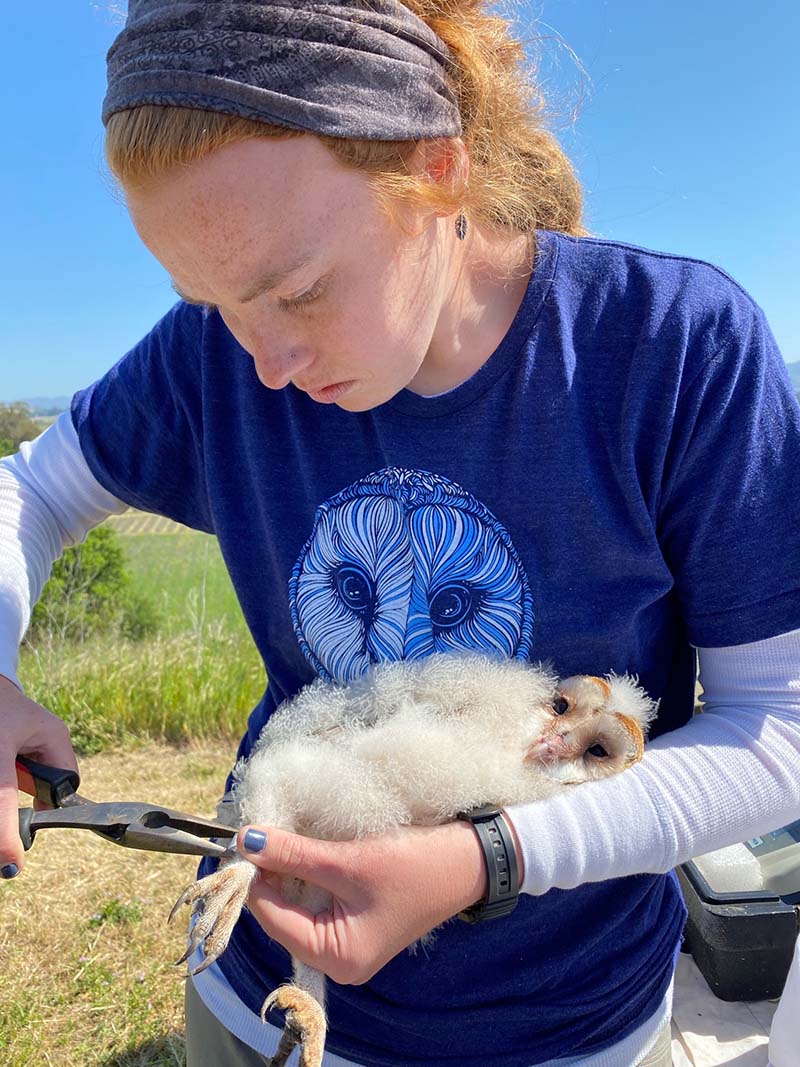
Echávez, Chavez, and Carlino are the most recent cohort to monitor as many as 280 nest boxes at the edges of 65 vineyards owned or managed by 15 different groups. At the end of each month, the researchers and volunteers look inside each box via GoPro cameras atop extendable poles. The adult owls will be weighed, measured, photographed, and banded.
“The funnest part is taking their photo” and seeing the variation in plumage, says Carlino.
Barn owls, the researchers have learned, are not exactly finicky, but they have decided tastes: wooden boxes placed at least three meters high facing away from the sun. They also strongly prefer some uncultivated grassland and avoid nest boxes near forests, according to published studies.
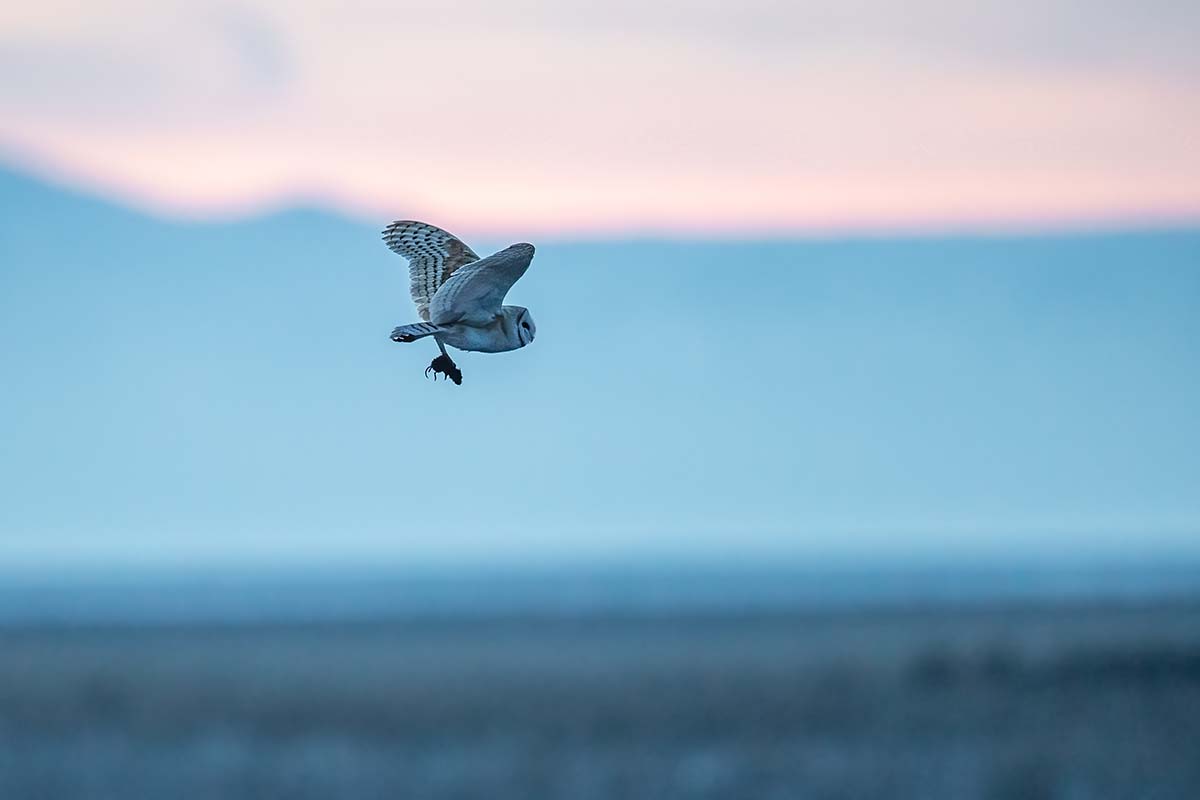
And they eat rodents — voraciously. During the four-month nesting season, when the Napa barn owls spend roughly one-third of their time hunting in the vineyards, a single family gobbles up about 1,000 rodents. Another study estimated a family eats an average of 3,400 annually. At that rate, a farmer with 20 nest boxes can expect barn owls to remove about 70,000 rodents from the vineyard and surrounding landscape. Gophers, mice, and voles are their main prey. Johnson’s team found preliminary evidence that owls reduce the gopher but not the mouse population. The data so far are inconclusive for voles.
That still leaves the question of whether barn owls actually affect the amount of pesticides winegrape growers use to reduce the damage done by rodents gnawing on vineyard roots and vines. “It’s really the bottom line,” Johnson says.
In the past, many California vintners have relied heavily on rodenticides that kill animals by inhibiting clotting and coagulation, ultimately leading to uncontrolled internal bleeding. Under a law that went into effect January 2021, the California Department of Pesticide Regulation severely limits rodenticide use, placing a statewide moratorium on use of the super-toxic poisons that kill birds and other wildlife up the food chain along with their intended targets.
Most of the farmers included in Johnson’s research project no longer use rodenticides. Among Napa Valley growers there is clear awareness of the risks and consequently very limited use of high-risk rodenticides, says Anna Brittain, executive director of Napa Green, a nonprofit that facilitates sustainability and climate action certification for wineries and vineyards in Napa County. Of the county’s 40,000 acres of vineyards, about 3,800 acres are organic, a certification that prohibits using synthetic chemicals.
A trend toward chemical-free farming statewide is reflected in the threefold increase of organic winegrape acreage since 2005. Napa County represents 18 percent of the total. But while the number of California’s organic vineyard acres has doubled in just the last decade, it remains a mere 3.5 percent of the land in the state planted with winegrapes. And even organic certification does not mean the growers do not use some rodenticides. The January bill includes a loophole that exempts all agricultural users, says Lisa Owens Viani, co-founder and executive director of Raptors Are the Solution (RATS), a San Francisco–area nonprofit that won a David versus Goliath battle through the rodenticide moratorium.
Scientists do not know “for sure” whether owls are reducing pesticide use, Johnson says. A 2019 survey of winegrape growers throughout California found that about 80 percent used barn owl nest boxes, 50 percent used kill traps for rodents, and 21 percent used rodenticides. Farmers with barn owl nest boxes reported using rodenticides at a lower rate than those who did not use barn owl boxes.
“Whether the use of barn owl boxes caused that reduction in rodenticides is, of course, not proven. Nonetheless, this result is encouraging,” Johnson says.
Elsewhere, owls and other raptors have confirmed their value as pest controllers. Tasked with protecting its county’s 47 miles of dirt levees and 56 dams from burrowing rodents, the Ventura County Watershed Protection Department tested replacing anticoagulant rodenticides with raptors. That strategy proved so successful that the department has stopped using these poisons altogether. Fourteen experimental perches attracting hawks, owls, and other raptors have expanded to 293, says David Torfeh, an environmental scientist with the department. He estimates the cost savings at around $218,600 per channel mile over 30 years. Other studies have documented the cost of barn owl predation at 26 cents per rodent versus trapping at $8.11 per rodent.
Johnson has been wondering how harnessing raptors for pest control affects the birds themselves. Napa’s barn owl nest boxes offer an opportunity to demonstrate that people and nature depend on each other—“that there’s an essential reciprocal relationship,” he says.
His research suggests that rodenticides do not deter owls from occupying nest boxes. That means owls are not avoiding areas with some rodenticide use, so they could be subjected to sublethal effects. A UC Davis team studying such raptors on farms found a relatively low exposure rate in barn owls; the poisons only last in the blood for a couple of weeks, however, so actual exposure could be higher than measured. It’s unclear whether the finding is a result of limited interaction between raptors and rodents that have ingested rodenticides or simply of low rodenticide use in the raptors’ foraging areas, says Breanna Martinico, a graduate researcher with the project. Over 20 percent of the juvenile red-tailed hawks the team studied in wintertime had been exposed to one or several rodenticide compounds. Understanding exposure levels is important because it can affect the health and behavior of these raptors, Martinico says.
Most farmers feel a strong connection to the land and want to do things that improve it. “If putting up owl boxes can help these birds, and if the barn owls are helping control rodents, well that’s even better,” Johnson says.
It’s unlikely that barn owls nesting in vineyard boxes will be the silver bullet that completely eliminates rodenticides in Napa Valley, but the data Echávez, Chavez, and Carlino are gathering is pinpointing just how barn owls are contributing. And it’s driving a better understanding of the benefits to birds, making the wine we drink—red or white—just a little greener.
If you’ve seen just one owl, it’s likely to be a common barn owl (Tyto alba). Impossibly cute, with a white heart-shaped face and dark, deep-set eyes, this mid-size owl is the most widely distributed species of owl in the world and one of the most widespread of all species of birds.
Barn owls are the undisputed grand champions of gopher gobbling. A single family in a California vineyard eats 3,400 rodents in a year, most of them voles, mice, and pocket gophers. Imagine the consumption worldwide, when you consider that barn owls are found on every continent except Antarctica. Then there’s the mound of pellets at the base of nest boxes—the Tootsie Roll–size wads of fur and bone owls cough up after a hearty rodent meal.
Credit their anatomy for their prowess as hunters. Barn owl eyes are directed in front of the head, giving them depth of focus. The owls’ sensitive hearing is enhanced by facial feathers, which form a concave ruff that acts as a reflector, directing sound into the ears. As with other owls, their wing feather design allows the movement of air through them to be silent.
“So armed, it’s little wonder that the Barn Owl has been so successful,” writes Paul Ehrlich, co-author of The Birder’s Handbook.
That success has benefited farmers around the world, who have had a big impact on where these owls hunt. “You can literally put a barn owl nest box in the exact location where you think you have a problem with the small mammals, and voilà! The owls will start using that area,” says John C. Robinson, a Bay Area–based ornithologist.
The barn owl’s common name reflects this species’ willingness to perform ecosystem services for humans. It has also prompted a facetious trope: “Imagine how excited Barn Owls were when humans invented barns.” In fact, barn owls have been around for millions of years, barns a mere several thousand. These birds were known in ancient Hebrew as tinshemet, which isonomatopoeic for their heavy breathing and hooting. Their pre-human nest sites include tree holes, caves, and dirt banks.
Another survival mechanism: Barn owls can’t count, so when John Comisky, with Napa Wildlife Rescue, finds a chick out of a nest box, he can return it to a family with chicks of a comparable age and the parents will accept it. You could call barn owls mathematically illiterate. Or you could credit them with an open-minded hospitality that sustains their species.
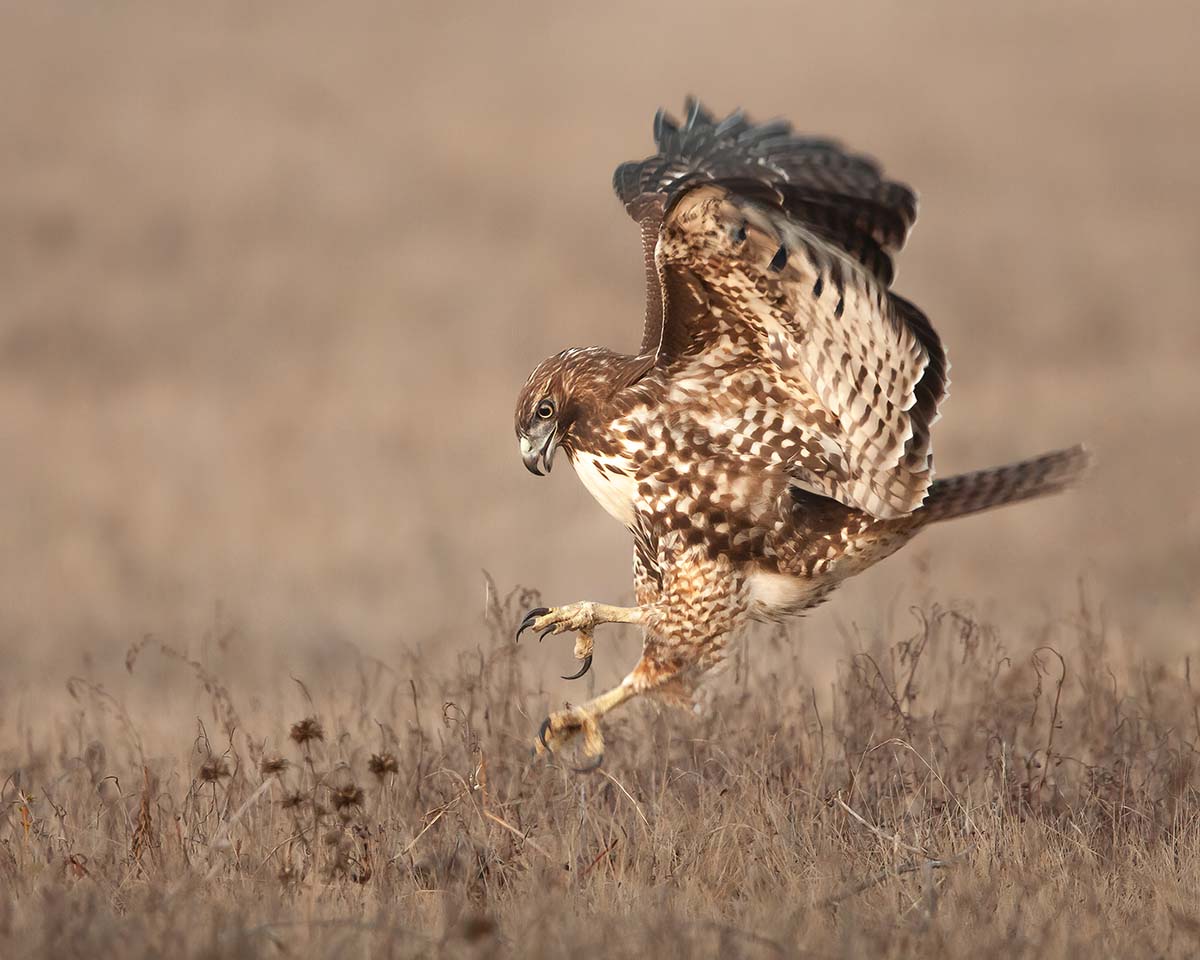
Few birds more powerfully evoke a longing to fly than red-tailed hawks (Buteo jamaicensis). Soaring above open fields, turning in slow, easy circles on broad, rounded wings, these birds are one of the largest many of us will see in North America. Along with the majesty of their effortless orbits, the redtail can kite, holding still against the wind on wings that span four feet.
That’s part of what makes these birds such prodigious hunters. They fly high, using eyes as much as eight times more powerful than humans’ to spot their quarry. They depend on gophers, voles, mice, and the occasional rabbit for the bulk of their diet. A study in Ventura County found that red-tailed hawks are the most common predators of the rodents burrowing into the dams and levees that protect public safety.
Despite an imposing hooked beak, it is talons that are redtails’ primary weapon. They grab their prey with their feet, extending long legs to protect their head and body while piercing their victim with long, penetrating claws. Once the prey is dead, the first part of it down the hawk’s hatch is the head. When prey is abundant, the hawks will sometimes eat only the heads, Robinson says.
For all their fierce predation, red-tailed hawks engage in a spectacular courtship ritual that begins with wide, elegant circles. Then the male dives steeply before shooting skyward at an angle nearly as sharp. After a few swoops, the male will fly down to the female, extend his legs, and quickly touch her. Occasionally, the pair will hold talons and fly in fast circles toward the ground before parting.
Let’s be clear: Western bluebirds (Sialia mexicana) do not eat gophers. Not even voles or mice. But bluebirds will eat grasshoppers and caterpillars; beetles, bugs, and ants; wasps, flies, termites, and scale insects. They catch them on the ground or in the air, on leaves and on stems.
Bluebirds are among the scores of birds that serve farmers as pest eradicators while satisfying their own needs. The overwhelming majority of songbirds are beneficial to agriculture during nesting season because they feed pest insects to their voracious nestlings, writes Jo Ann Baumgartner, executive director of the Wild Farm Alliance, in a guide to pest-controlling birds for farmers. Like raptors, which farmers have employed for millennia as ecosystem supporters, insect-eating birds can help reduce the need for chemical pesticides.
Scientists have found that adding nest boxes to vineyards almost quadrupled the abundance of insect-eating avian species. The density of Western bluebirds alone increased tenfold where boxes were added, and the species richness of avian insectivores increased by over 50 percent. A 2011 study found 2.4 times more beet armyworms removed in vineyards with bluebird nest boxes than in those without. The rate of larval removal averaged 3.5 times greater with occupied boxes than unoccupied.
How do we know this is bluebirds at work? “We collect bird poop and scan it to see what they’re eating,” Julie A. Jedlicka, author of the study, published in the scientific journal PLOS ONE, told SF Gate.
This species is declining, and scientists think they know why. Western bluebirds nest in tree cavities, relying on woodpeckers and other species with better-equipped bills to do the drilling for them. Logging and conversion of forests to other uses have diminished their habitat. So have vineyards, where expansion has contributed to the conversion of over a million acres of California oak woodlands and savannas. Audubon’s climate model forecasts a 64 percent loss of current winter range by 2080.
Western bluebirds weigh less than an ounce, but their power as ecosystem supporters packs a wallop. And their happiness quotient? Incalculable.
Support for this article provided by the March Conservation Fund.
About the Author
Based in the northern Sierra Nevada, Jane Braxton Little is an independent journalist covering science and natural resource issues for publications that include Scientific American, National Geographic, Audubon, Discover, High Country News, and Bay Nature.