
Pam Strayer | Wine Business Monthly
Should sustainability guidelines allow growers to use Roundup? No, says Napa Green, the local sustainability certification in Napa Valley which announced last month that it will require phasing out of the world’s most popular herbicide by 2026 due to its impact on soil health.
This makes Napa Green, “the first sustainable winegrowing certification globally to require the phaseout of Roundup, and ultimately synthetic herbicides,” the group said in a press release.
Media, Consumers and Terroir Shaped Napa Green’s Path to Synthetic Herbicide Free
“About 64 percent of our members and transitioning members don’t use synthetic herbicides already,” said the nonprofit’s Executive Director Anna Britain in an interview with WineBusiness.com.
Britain cited being true to terroir as a consideration in the decision.
“What we are saying is that (soil organism) diversity increases resilience, and (synthetic) herbicides reduce diversity. So the herbicides are reducing the health of the fungal and microbial networks that are deeply tied to the functioning and the health of the plants above ground.”
Backing up this claim are numerous studies that show decreases in soil health. According to a 2018 Austrian study three leading herbicides–flazasulfuron, glufosinate, and glyphosate–“reduced grapevine root mycorrhization on average by 53 percent compared to mechanical weeding.” (https://www.ncbi.nlm.nih.gov/pmc/articles/PMC6096560/)
“It’s hard to keep talking about leading regenerative soil health practices and terroir–this idea that grapes are an expression of place–if we’re undermining the soils that those vines and grapes are coming from,” Brittain said.“There’s been more consumer demand and media demand putting growing attention on this issue and we recognized that allowing Roundup and other synthetic herbicides goes against our focus on soil health,”
The decision to phase out synthetic herbicides was the result of a working committee’s research and recommendations. Representatives from Ehlers Estate, Foley Family, Spottswoode, and Treasury Wine Estates were on the committee.
Town Hall Community Conversation
Speaking Dec. 7 at a town hall meeting to discuss the group’s new direction, Ben Mackie, the sustainability group’s vineyard program manager, explained, “It’s pretty clear…that putting less chemicals into the environment is going to end up with a healthier environment.”
“Some of the specific science is that [the herbicide] reduces biological activity in the soil… it’s reducing fungal activity…it’s reducing earthworm activity, both reproductive and just their general ability to move through the soil and find things to eat. It reduces bacterial biodiversity.”
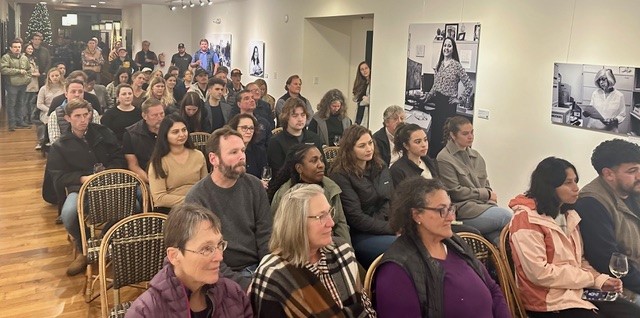
The town hall featured a panel with three vineyard managers with varied backgrounds farming diverse types of sites, speaking before a packed gallery hall at St. Supery in Rutherford.
Speaking were Erik Dodd from Wight Vineyard Management (which farms for clients all over Napa), Ashley Anderson-Bennett from Cain (who farms steep terraces on Spring Mountain), and Ivo Jeramaz from Grgich Hills (who farms five diverse estate vineyards on 360 acres, ranging from the Carneros to Calistoga). The panelists were invited to talk specifics on costs, labor, benefits and ROI on herbicide-free viticulture.
Costs depend on the site and the season, experts said.
“I tell people to expect maybe a 15 to 20 percent cost increase,” said Dodd, if you have a brand new site where you’re going in and going to go ahead and not have any herbicides at all. If you’re tapering out of a system that has used pre emergents, you’re going to see that be substantially less at first…”
“When we had drought years, like 2021 and 2022, we saw way less weed activity. This last year, way more weed activity. So those numbers can vary widely by growing season. It’s not at all a blanket statement that you can say it’s going to be that specific number.
Sheep are effective, too, panelists said. “That is a great alternative that we’re using that works really well on sites where we have a lot of hillside and terrain to maybe move them in during the rainy events, and then back in the vineyard,” Dodd said. “It’s not perfect for every site, but it is a great tool when it works.”
Cain’s Anderson-Bennett farms steep, terraced hillsides and has had to replant since the Glass Fire burned the vineyard and all her equipment. She lamented the loss of her favorite tool. “The double sided sunflower was really the thing that worked best for us. Unfortunately, they don’t make it anymore. And mine burned up from the fire, so I can’t get another one. If anyone has a used one, let me know,” she said.
Weed control on Cain’s super steep terrain relies more heavily on weed eaters and shovels, which made her weed control costs higher than average, Anderson-Bennett said, adding up to about $1,200 to $1,500 an acre.
The winery originally went herbicide-free over concerns about worker health. She said the crew now reports to her about their friends who work at places farming with more chemicals skeptically and appreciates that Cain does not use the more toxic chemicals.
“In a mature flat vineyard…It should be pretty easy to get by without Roundup… that’s just my personal opinion…Because if I can do it in my conditions, then really anybody can.”
She praised Napa Green for phasing out Roundup, “I’m so happy that you guys are doing this. I think it’s great,” she said.
Jeramaz says his costs are very low, compared to the average in Napa, which an accounting firm he consulted calculated at $15,000 per acre. In comparison, his are $11,000 an acre, he said.
Shifting Vineyard Aesthetics from Bare Soil to Greenery
Old timers were the most likely to object to greener middles, as opposed to vineyard rows of bare, exposed soil, the group said.
Said Dodd, “The first thing I say to people is it just takes a little bit of a mind shift. You’re gonna see weeds in the vineyard. There’s no way around it, and you have to have some tolerance for that, and just prepare the winemaker, the owner, the tasting room staff–everybody. It’s just not going to look the way it used to look and that’s okay. It doesn’t have to be perfectly tidy to have wonderful wine quality.”
Working a large site in Oak Knoll on the valley floor, Dodd said, “The first year, fully cultivated. The second year, with all the more vigorous rootstocks and cover crop permanently left. And then third year just about everything [left]. I find it to be pretty simple. That way you end up with nice, flat, level, middle ground where you can spray on and sulfur dust and do the things you need to do there and then under vine cultivation.”
Roundup’s Pervasive Dispersal: Debates on “Safe” Exposure Levels Continue
Consumer concerns have grown over the years as evidence mounts that the herbicide’s presence is pervasive–found by the Centers for Disease Control (CDC) in the urine of 87 percent of humans tested –as scientists continue to debate what level of exposure is safe.
The largest and most comprehensive study, the Global Glyphosate Study (which includes U.S. scientists among its international brain trust), released preliminary findings last month contradicting the levels regulators say are safe–and reporting that those levels are not safe based on extensive, new animal studies that showed lab rats getting leukemia, another blood cancer, from three different concentration of glyphosate. The researchers remarked that the rats were also dying at ages far younger than they had seen in any research.
The study looked at glyphosate alone, Roundup (the product as formulated for residential users), and the industrial strength PowerMax, outlawed in the EU, but legal in the U.S. (and typically the product used in vineyards).
Glyphosate can stay in the soil far longer than initial Monsanto and Bayer estimates, according to the USDA’s former top glyphosate researcher, Robert Kremer, a 32 year veteran of the department, who is adjunct professor of soil science in the Division of Plant Science and the School of Natural Resources at the University of Missouri.
“We see it remaining in the soil from 23 days to almost 200 days. But we’re seeing much longer half lives than that,” he said.
“It interferes adversely with the soil mycorrhiza… Some beneficial groups can be depleted or decreased considerably…and some other plant detrimental types would be increased.” His research is available at https://cafnrfaculty.missouri.edu/rkremersoilhealth/
In addition, Kremer said that the herbicide reduces the soil’s ability to sequester carbon.
Consumers, the Court of Public Opinion, and the EU
Will being Roundup free matter to consumers? Britain could not point to specific data for the U.S, but said anecdotally more and more consumers are asking vintners if they use it.
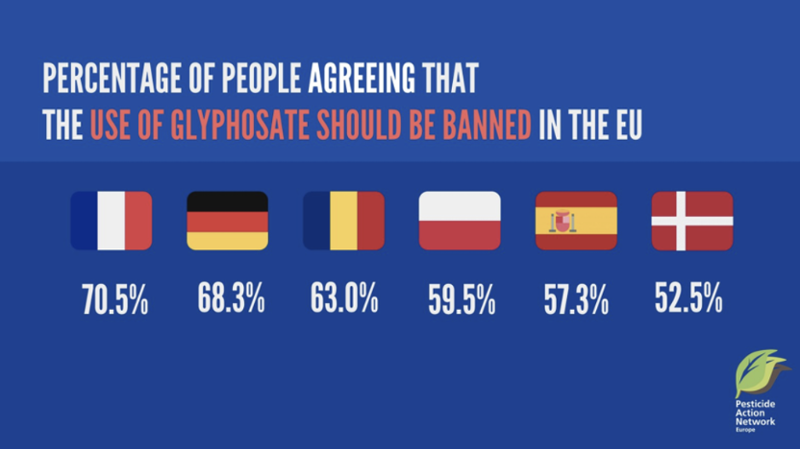
Data in the EU, where opinions on the herbicide are more heated and Roundup is more politicized, showed a majority of citizens favored a ban on the herbicide, while farmers favored its continuation. The study surveyed 6,000 people across six countries in August and was released in October from Pesticide Action Network Europe.
The Napa Green phase out includes not only glyphosate based products but other synthetic herbicides, including glufosinate ammonium, a synthetic herbicide some vintners have switched to to avoid saying they use Roundup. The deadline for phasing that out for Napa Green members is 2028.
While the Napa Valley Grape Growers released data in November showing that Roundup use had halved since 2018, public data shows that glufosinate ammonium acreage rose 28 percent from 2017 to 2021, increasing from 7,596 in 2017 to 9,731 in 2021, as growers tried to avoid saying they used Roundup.
“The World Health Organization (WHO) says glufosinate ammonium is more dangerous than Roundup,” Brittain said.
Bay Area Court Cases Focused Public Attention
The first three lawsuits took place in the Bay Area starting in 2018, with winning verdicts for plaintiffs Dewayne “Lee” Johnson, a school groundskeeper in Vallejo, who was ultimately awarded $21 million; Sonoma county resident Edwin Hardeman, who used the herbicide to control poison oak and was awarded $25 million; and an elderly couple, Alva and Alberta Pilliod of Livermore, who used it on their backyard vegetable garden and were awarded an $87 million settlement.
Professional pest control experts criticized the Johnson case for his lack of protective gear and insufficient training, but most court cases have centered on residential users. (In 2021 Bayer announced it would withdraw the product from residential use at the end of 2023.)
According to Reuters, there are still 165,000 claims. The news agency reports, “In 2020, Bayer settled most of the then-pending Roundup cases for up to $10.9 billion. Around 50,000 claims remain pending, according to regulatory filings.”
Roundup in the News
A new court ruling in Missouri made front page news Nov. 17 when jurors ordered Roundup maker Bayer to pay four victims $1.56 billion.
On Dec. 8, a new, feature length, anti-Roundup film, Into the Weeds, launched on major streaming channels in the U.S., including Amazon, iTunes, Vudu, GooglePlay and Xbox.
There’s still time to register for the @napagreen and @regenerativeviticulture #OneBlockChallenge informational sessions!
Register for either session at the link in our bio:
December 9th from 9:00-10:00 am
December 11th from 9:00-10:00 am
#soilhealth #regenerativeviticulture
@napagreen and @regenerativeviticulture partnered to bring the #OneBlockChallenge to Napa County winegrowers!
Tomorrow is the first virtual informational and onboarding session, so bring your questions, curiosity and excitement and hop on zoom to learn more.
#climateaction #regenerativeviticulture
Help us celebrate this historic milestone!!
100% of @napagreen’s Certified Vineyard members successfully phased out Roundup, setting a new standard for wine industry leadership.
Thank you to all of our members for your continued leadership and dedication to sustainability. Your choices impact meaningful change in our industry.
#climateaction #winebusiness #regenerativeag
What makes the #OneBlockChallenge so special? Hear from @regenerativeviticulture Co-Founder, @stephen_de_mirabeau!
The first informational session is next week so come with your questions. Learn more or get involved at the link in our bio.
#regenerativeag #regenerativeviticulture climateaction

@napagreen is a non-profit focused on climate action in the wine industry!
This #GivingTuesday consider donating any amount to support regenerative farming practices, sustainable wine production, and strengthening our community.
#climateaction #nonprofit
Happy Thanksgiving! We are so grateful for our incredible members and their teams, the community, our board, and all of the people who support climate action by drinking @napagreen certified wines!
Cheers! 🍂 🍁 🍃
#climateaction #nonprofit #wineindustry
Join us @beringervyds Hudson House on December 11th for wine and updates!
At the end of each year we like to bring together our team, members, and community to discuss some of the highlights from the past year, and what’s ahead in the new year.
➡️ Ticket link in bio.
#community #nonprofit #winetasting
What is regenerative viticulture and where do I even start?!?
Last week, @napagreen and @regenerativeviticulture launched the #OneBlockChallenge in Napa, creating an accessible pathway for growers to start with just one block, while providing support and mentorship for regenerative practices.
To hear the workshop recording from @chuckschembre or to learn more about the One Block Challenge or Napa Green Vineyard Certification, head to the links in our bio.
#climateaction #regenerativeag
@napagreen has a @candiddotorg GuideStar Gold Seal of Transparency, which shows our nonprofit’s commitment to accountability. It also let donors see insights into our organization and operation to make informed donation decisions!
Our valuable climate action work cannot happen without the support of our community, members, donors and sponsors!
Want to donate or make an impact in another way? Head to the link in our bio or reach out to connect.
#climateaction #nonprofit #nonprofitorganization
Day 2 of our Growing Regenerative Viticulture event was amazing!
We learned about the onsite regenerative practices from @bedrockmorgan and @j_neustadt, heard the technical side of how these practices work from @chuckschembre, learned sampling techniques from @soilrainandhope, and saw the data and insights from @sectormentor and @grape_cowboy.
Thanks to all who attended and to @bedrockwines for hosting!
➡️ To learn more about regenerative vineyard practices or to enroll in either the One Block Challenge or Napa Green Vineyard certification, head to the links in our bio.
#regenerativeag #climateaction #vineyardmanagement #oneblockchallenge #napagreen #regenerativeviticulture #soilhealth #biodiversity #carbonfarming
Today @napagreen and @regenerativeviticulture proudly launched the One Block Challenge in Napa, an initiative to encourage winegrowers to adopt regenerative viticulture practices on a manageable scale.
We heard from an incredible group of regenerative agriculture experts, practitioners, and leaders who shared valuable insights and success stories.
Thanks to our attendees, @opusonewinery for hosting, and our exceptional speakers: @chuckschembre @stephen_de_mirabeau @cainethompson @soilrainandhope @forrestellab and @hilarysgraves.
➡️ Visit the link in our bio to sign up for the One Block Challenge or learn more!
#regenerativeag #climateaction #vineyardmanagement #oneblockchallenge #napagreen #regenerativeviticulture #soilhealth #biodiversity #carbonfarming
Applications for the California Green Medal Sustainable Winegrowing Leadership Awards 2026 awards are now open!
California’s wine industry is a global leader in sustainable practices due to the dedication of its vineyards and wineries in setting high standards for: 🍇 Environmental stewardship
🍇 Being a responsible employer and community member
🍇 Implementing innovative and sustainable business practices
We invite you to apply for the California Green Medal Sustainable Winegrowing Leadership Awards to highlight your excellence!
Apply Now at greenmedal.org/apply.
#CAGreenMedal #SustainableWine #WineIndustry #Sustainability #SustainableWinegrowing
#CaliforniaGreenMedal #WineBusiness #Wine
What Do Consumers Ask Winemakers Most Often? Chimney Rock Has Some Answers
We love this @grapecollective conversation with @elizvianna, the Winemaker and GM @chimneyrockwinery!
#sustainablewine #winetasting #winebusiness #regenerativeag
We are thrilled to be nominated for the @napachamberofcommerce Community Benefit Organization of the Year!
🗳️ Cast your vote daily from now until November 21st. Link in bio!
#nonprofit #napavalley #chamberofcommerce
Congratulations to @phiferpavittwine on achieving both @napagreen Vineyard and Winery recertification!
Phifer Pavitt has mindfully cultivated a thriving ecosystem where every element - from insects and plants to earthly materials - serves a purpose and repurpose.
We invite you to book a tasting to explore their innovative Eco Barn, serene pollinator garden, and exemplary environmental stewardship practices. When you visit, you will discover wines that not only capture a sense of place but also embody a living testament to regenerative farming from soil to bottle.
#sustainablewine #climatesmart #napavalleywine #napavalley #winebusiness #sustainablewinery #wineindustry #sustainablebusiness #womenownedwinery #landstewardship #environmentalstewardship #regenerativeag
Congratulations to the 2025 @winebusinessmonthly Wine Industry Leaders!
We`re thrilled to see many of our members, partners, speakers, sponsors, and community leaders recognized for their innovative contributions and leadership in the wine industry!
Special thanks to @napavintners President and CEO, Linda Reiff, for championing environmental efforts in the Napa Valley wine industry by establishing the @napagreen program!
#winebusiness #wineindustry #environmentalstewardship #napavalleywine #napavalley